Executive Summary: The Gulf Climate Maintenance Reality
Most motorists discover their vehicle requires attention approximately ten seconds after it becomes undriveable—an ominous rattling on Sheikh Zayed Road, a coolant gauge spiking in rush hour August traffic, or a battery that collapses without warning overnight. In the UAE, where ambient heat reaches 50°C and tarmac radiant temperatures exceed 70°C, the margin between a harmless minor quirk and a multi-thousand dirham catastrophic breakdown vanishes in days.
Gulf summers accelerate battery chemical decay, dry out rubber bushings and wiper blades, and rapidly degrade synthetic engine oils.
A 15-minute monthly visual DIY routine, professional bay inspection every 3 to 6 months, and an annual diagnostic system scan.
In the UAE luxury and supercar segment, verifiable continuous service documentation preserves up to 25% higher market resale valuation.
Why Checkups Beat Costly Roadside Repairs
Modern motorcars are complex symphonies composed of thousands of mechanical and electronic components wearing down at vastly differing velocities. Brake friction pads thin millimeter by millimeter. Engine oil additives deplete as thermal viscosity breaks down. Tyre air pressure steadily bleeds 1 to 2 PSI per month regardless of whether the vehicle is cruising down Al Khail Road or parked inside an air-conditioned basement.
Crucially, modern vehicles are engineered to deliver a seamless, isolated driving feel right up until the moment of mechanical failure. Routine checkups completely flip this economic equation:
The Escalation of Ignored Wear: A Real-World Example
A worn brake pad detected during a routine 3-month inspection represents a fast, affordable pad replacement. Left unchecked, the exposed backing plate scores the steel rotor, turning the bill into a full rotor and pad replacement. Ignored further under high thermal stress, heat radiates directly into the caliper pistons, destroying hydraulic seals and multiplying the repair invoice tenfold. Same root problem; drastically different outcomes.
The Dubai Vehicle Checkup Schedule: Component Breakdown
Because European and North American manufacturer schedules assume mild average temperatures and clean asphalt, vehicle owners in Dubai must adapt their inspection rhythm to combat intense thermal degradation and microscopic sand infiltration.
| System / Component | Recommended Frequency | Inspection Type | UAE Climate Impact Factor | Action Needed If Faulty |
|---|---|---|---|---|
| Engine Oil & Filter | Monthly dipstick / 5,000–8,000 km | DIY / Pro Bay Flush | Extreme heat shears viscosity, turning oil gritty & black | Immediate synthetic oil & OEM filter change |
| 12V / 48V Battery | Every 3–6 Months | Electronic Load & Conductance | Batteries fail abruptly after 18–24 months in UAE heat | Proactive replacement before total non-start |
| Tyre Pressure & Tread | Every 2 Weeks / Monthly (Cold) | Pressure Gauge & Depth Gauge | Superheated asphalt triggers blowouts; dry rot cracks | Cold PSI adjustment, rotation, or RTA replacement |
| Cooling System & Belts | Monthly Level / 6-Month Test | Pressure Test & Visual Scan | Coolant evaporation & hose embrittlement risk warping heads | Coolant top-up, hose clamp tightening, flush |
| Braking Pads & Rotors | Every 6 Months | Micrometer & Fluid Boil Test | High-speed highway braking causes thermal glazing & fade | Pad replacement, rotor resurfacing, brake bleed |
| AC Cabin & Air Filters | Every 3–6 Months | Visual & Airflow Measurement | Desert dust & silt choke filters, overworking compressor | OEM HEPA/Carbon cabin & intake filter swap |
| Suspension & Bushings | Annually (Full Lift Inspection) | Play & Stress Testing | Rubber control arm bushings bake and perish, causing clunks | Hydraulic bushing replacement & laser alignment |
Master Technician Inspection Protocol
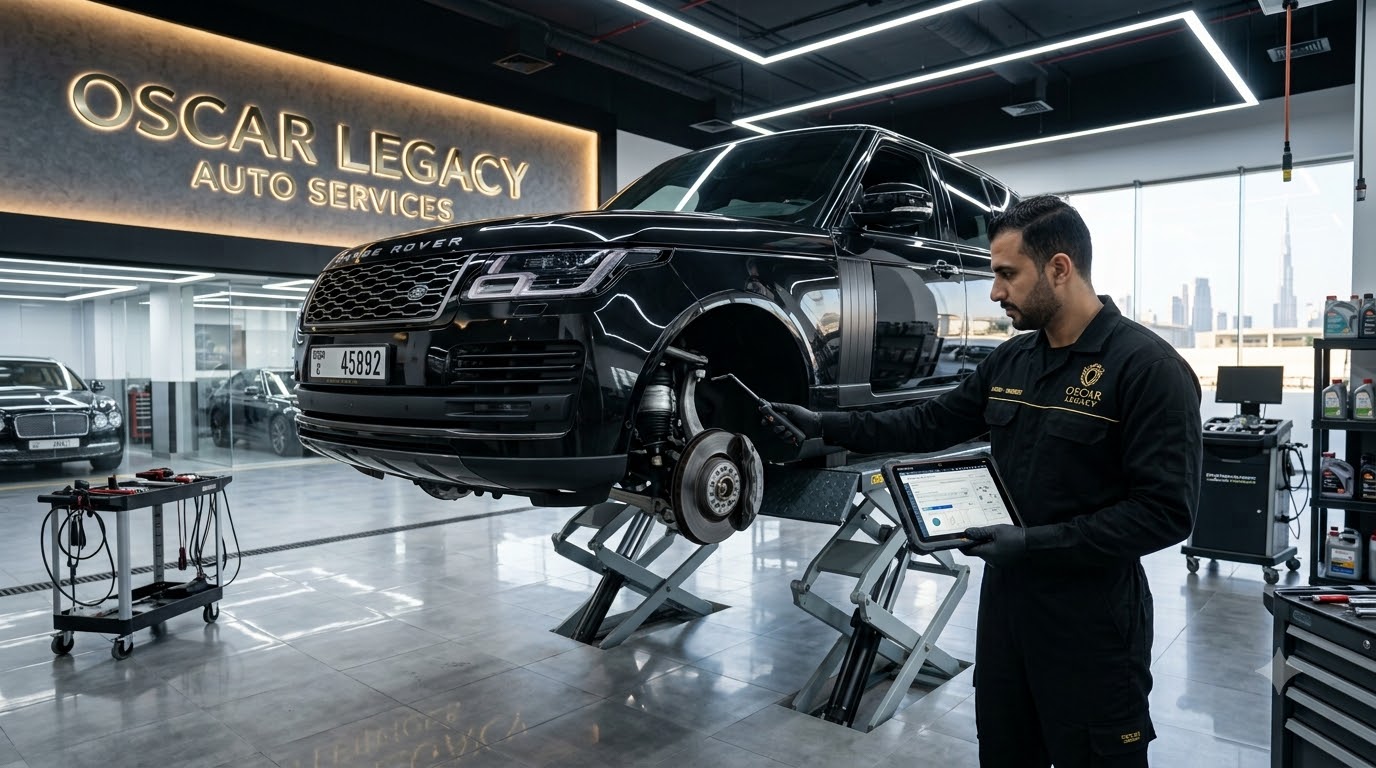
At Oscar Legacy Auto Services, our multi-point vehicle inspection protocol exceeds factory standards. Utilizing OEM diagnostic scanners for Bentley, Rolls-Royce, Porsche, Ferrari, McLaren, Lamborghini, and Mercedes-Maybach, our certified technicians identify hidden micro-faults and thermal fatigue before warning lights illuminate your dashboard.
- Full live ECU/TCU module telemetry interrogation
- Fluid spectrographic analysis & moisture boiling point testing
- High-precision chassis and subframe laser alignment audit
The Three Overlapping Inspection Tiers Explained
Rather than viewing maintenance as an unpredictable headache, high-end vehicle owners establish a structured three-tier cadence that guarantees pristine mechanical reliability year-round:
The 15-Minute DIY Walkaround
Conducted on a quiet weekend morning while the powertrain is completely cold:
- Engine Oil: Pull dipstick, wipe clean, re-dip. Verify oil level is between marks and retains an amber-to-honey tint without milky grit.
- Cold Tyre Pressures: Check with digital gauge against driver-door sticker values, never sidewall max.
- Fluid Reservoirs: Glance at translucent coolant expansion tanks, brake reservoir, and washer fluid.
- Exterior Lighting: Back toward a reflective wall at night to verify rear taillights, brake clusters, and indicators.
The Workshop Bay Inspection
Professional examination on hydraulic lifts by certified master technicians:
- Battery Load Testing: Measuring cold cranking amps (CCA) and internal conductance to avoid abrupt roadside flatlines.
- Brake Rotor & Pad Wear: Micrometer precision thickness measurements and inspection of inner pad taper.
- Air Conditioning Efficiency: Compressor cycling check, refrigerant pressure, and cabin microfilter swap.
- Undercarriage & Axle Boots: Examining CV boots and steering racks for dust abrasion or grease leaks.
The Annual Deep Diagnostic Audit
A forensic mechanical and electronic health certification:
- Full Electronic Scans: Interrogating stored freeze-frame fault codes across powertrain, CAN-bus, and body modules.
- Transmission & Differential Fluids: Verifying fluid clarity, odor, and micro-metallic sediment levels.
- Suspension Kinematics: Inspecting adaptive air suspension bladders, valve blocks, and ride height linkages.
- RTA Roadworthiness Pre-Check: Ensuring emissions, tyres, and safety gear pass annual Dubai registration renewal.
Daily Habits That Extend Your Car's Lifespan in the UAE
Mechanical inspection schedules must be paired with proactive driving and ownership habits to protect your vehicle against extreme Middle Eastern environmental stressors:
1. Never Wipe Dry Desert Dust
Dubai sand consists of sharp quartz and mineral particles. Wiping dusty body panels with a dry cloth acts like 2000-grit sandpaper, scratching clear coats instantly. Always use high-pressure pre-washes or snow foam.
2. Allow Gentle Thermal Stabilization
Avoid immediate full-throttle pulls right out of parking garages. Allow engine oil to reach optimal operating temperature (85–95°C) before unleashing performance. Similarly, let turbocharged engines idle 60 seconds after spirited highway runs.
3. Park Under Cover or Install PPF
Unprotected automotive paint subjected to direct midday Dubai UV radiation degrades in less than 24 months. Utilizing shaded carports, high-grade ceramic window films, or self-healing TPU PPF isolates your investment from harsh solar weathering.
Why Choose Oscar Legacy Auto Services for Vehicle Inspection & Care
Exotic, prestige, and high-performance supercars demand technicians who comprehend their unique architectural tolerances, not generic mechanics. At Oscar Legacy Auto Services in Dubai, our bespoke workshop bays are engineered specifically to cater to ultra-high-end vehicles:
- OEM Dealer-Grade Scanners: Dedicated telemetry systems for Porsche PIWIS, Mercedes Star Xentry, BMW ISTA, and Ferrari/Lamborghini diagnostics.
- Climate-Tuned Maintenance: We formulate all fluid service schedules, viscosity grades, and inspection thresholds specifically for UAE heat and sand exposure.
- Complete Aesthetic & Mechanical Integration: Seamlessly pair your mechanical inspection with paint correction, ceramic coatings, window tinting, or bespoke upholstery rejuvenation under one roof.
Frequently Asked Questions
Ensure Peak Performance & Zero Roadside Surprises
Protect your automotive investment with a comprehensive multi-point health check at Oscar Legacy Auto Services in Dubai. From dealership-grade electronic diagnostics to precision fluid analysis, we deliver unmatched peace of mind.