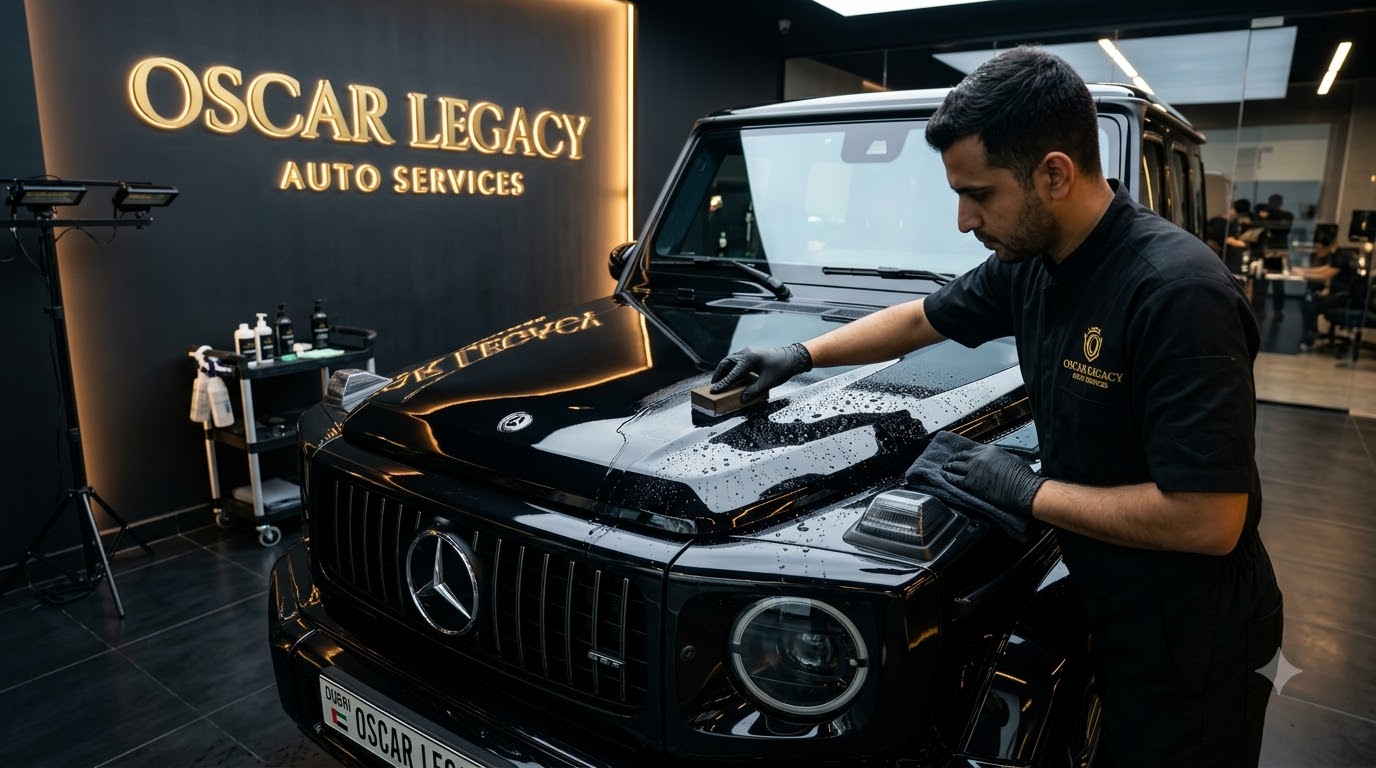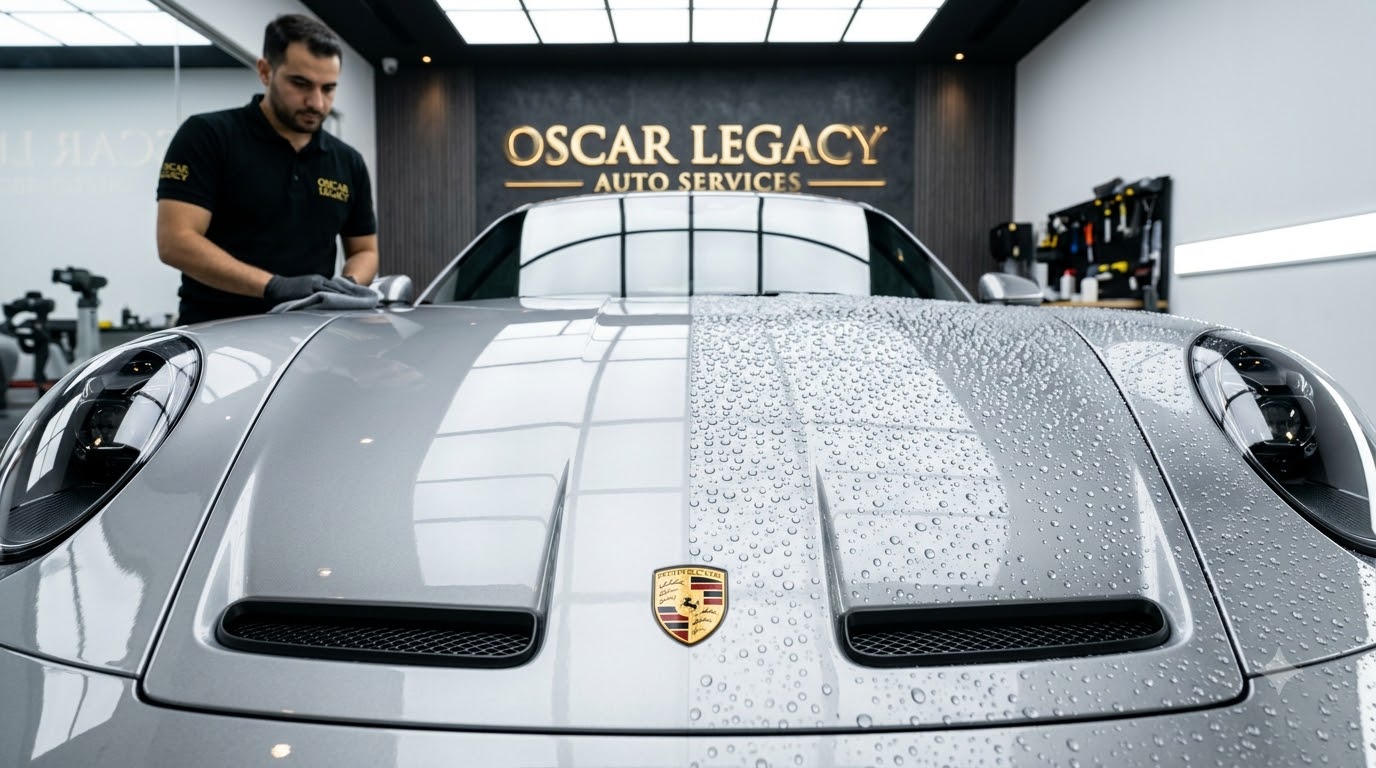
Leave a black car parked outside in Dubai for one August afternoon and you'll see the problem. The roof is too hot to touch, there's a film of fine dust on the bonnet, and the sprinklers have left a pattern of chalky spots across the doors.
We see the results of this every week at our studio. Ferraris, Lamborghinis, Rolls-Royces, Bentleys: cars that cost a fortune and were bought partly for how they look. In this city, keeping that paint perfect takes real effort. For years, ceramic coating has been the standard answer. Lately, more clients come in asking about graphene. They've seen it on social media, a friend has it, or another detailer told them it's "the next level." The question we hear most is simple: is graphene actually better, or is it just a new label on the same thing? The honest answer is that it depends. At Oscar Legacy Auto Services, we explain the chemical facts without the marketing fluff.
1. What's Actually in the Bottle
Ceramic Coating: Most ceramic coatings are built on silicon chemistry, mainly silica-based (SiO2) and organosilicon compounds. Once applied and cured, they form a thin, hard, cross-linked layer held together by silicon-oxygen bonds. On a car, that layer gives you a harder surface that resists light marring, strong water beading, better resistance to everyday contaminants, and the deep gloss people pay for. There is one common myth to clear up: a ceramic coating is not a layer of glass or quartz sitting on your paint. It's a carefully balanced chemical formula. How well it performs depends on that formula and on how well it's cured.
Graphene Coating: Graphene is carbon arranged in a single flat sheet of hexagons, like a honeycomb one atom thick. In its pure form it is extraordinarily strong and extremely good at moving heat. Here's what the brochures tend to leave out: the graphene coating on your car is not pure graphene. Almost every automotive "graphene coating" is a ceramic or polymer coating with graphene-derived materials mixed in, usually graphene oxide or reduced graphene oxide (rGO). Put simply, most graphene coatings are upgraded ceramic coatings, not a completely different technology. Those additives can improve barrier performance, surface behaviour, and heat transfer. But the remarkable properties of pure laboratory graphene don't automatically carry over just because some graphene is in the mix.
2. Side by Side Comparison: Ceramic vs Graphene-Enhanced Coating
Here is how the two coating systems compare across every practical performance benchmark:
| Evaluation Criteria | Ceramic Coating | Graphene-Enhanced Coating |
|---|---|---|
| Base chemistry | Silicon-based cross-linked network (SiO2/Polysilazane) | Ceramic or polymer base with graphene-derived additives (rGO) |
| Heat behavior | Stability depends on the formula | Possible thermal benefits (needs product-specific testing) |
| Water spots | Hydrophobic, but spots can still form in sun | Some formulas release water & minerals more easily |
| Dust & Static | Slick surface makes cleaning easier | Possible advantages; antistatic claims aren't guaranteed |
| Hardness | Usually advertised as 9H (Pencil test) | Some premium products claim 10H (Pencil test) |
| Gloss & Depth | Deep and reflective | Deep and reflective; varies by product |
| Durability | Depends on product, curing, and maintenance | Depends on product, curing, and maintenance |
| Price Positioning | Established premium industry standard | Usually positioned a tier higher |
If you remember one thing from this guide, make it this: graphene gives chemists another tool to work with, but a well-made ceramic coating will beat a poorly made graphene one every time.
Oscar Legacy Studio Diagnostic: Coating Performance Standards
Verified Technical Benchmarks for Dubai Extreme Climate (50°C+ Sun • Mineral Fallout)
3. Heat: Graphene vs 9H Ceramic Under the Dubai Sun
Heat is the selling point you'll hear most often for graphene in the UAE, and it's easy to see why. In summer, dark panels like the roof and bonnet get far hotter than the air around them, heating up and cooling down day after day for months. Pure graphene conducts heat across its surface exceptionally well, so the idea of spreading heat away from hotspots sounds very appealing.
A real coating on a real car is more complicated. How much heat a coating actually moves depends on how much graphene is in it, whether it's evenly spread or clumped together, how well heat passes between the graphene and surrounding polymers, film thickness, paint colour, and ambient conditions. A coating that is only a few microns thick, with a small amount of graphene, will not cool your bonnet by some fixed number of degrees. If a product claims that, ask to see independent test results. For Dubai, the more useful questions are: How does the coating hold up after long periods of heat and UV? Does it keep beading water after a full summer? Has it been tested through repeated thermal cycles? Those answers matter far more than graphene's lab-sheet numbers.
4. Water Spots: A Constant Problem in Dubai
If you own a black, dark blue, or deep metallic car, you already know about water spots. A drop of water dries in the sun and leaves its minerals behind. Dubai water, especially from landscaping sprinklers, carries plenty of dissolved minerals. Leave those spots long enough in strong sunlight and they can stain or even etch into clear coat.
Both ceramic and graphene coatings are hydrophobic, which makes the car much easier to rinse and dry. Does graphene help with water spots? Some graphene-enhanced formulas do seem to shed water more readily and hold onto minerals less, which is a genuine plus for cars parked outdoors near villa sprinklers or washed frequently. But there's a catch that surprises many owners: a hydrophobic coating can actually make spotting worse in some situations. Tight, round water beads sitting on a flat bonnet under direct sun act as miniature magnifying lenses where mineral rings bake in. What actually keeps your paint clean is the coating's overall water behaviour, its chemical resistance, and how you look after it. For a collector car, that means filtered or deionised rinse water and drying promptly, whichever coating you choose.
5. Dust: Can Graphene Keep a Car Cleaner?
Dubai dust is fine, ubiquitous, and abrasive. Apart from making the car look neglected within a day, it's also the main cause of swirl marks, because gritty particles dragged across paint by a wash mitt leave fine scratches. Graphene coatings are often sold as "antistatic," on the logic that graphene conducts electricity and so dust won't stick.
The reality is less simple. Graphene oxide, which is what many automotive coatings actually contain, is a fairly poor conductor. For a coating to really dissipate static charge, it needs a continuous conductive network, and adding a small percentage of graphene doesn't guarantee that path exists. What you can realistically expect: a properly applied coating with a slick, low-friction surface will make dust much easier to wash off without friction. No coating, graphene or ceramic, will keep a car dust-free or protect paint from someone wiping it with a dry cloth. In this city, how the car is washed matters far more than any claim about repelling sand.
6. 10H Graphene vs 9H Ceramic: What the Numbers Mean
"9H" and "10H" sound like solid measures of toughness, but they aren't what most consumers assume. The "H" comes from pencil hardness testing (ASTM D3363), where pencils of increasing lead hardness are pushed across a cured film at a 45-degree angle to see which one marks it. 9H is the top of the standard pencil scale. When a product claims 10H, it's fair to ask which test protocol was used and who certified it, because without standard documentation the number can't be objectively compared.
Crucially, this is not the geological Mohs scale used for minerals (where diamond is 10 and talc is 1). A 9H or 10H pencil rating tells you nothing certain about how the coating handles high-speed sand abrasion, stone chips, or wash swirls. If you're worried about stone chips on Dubai motorways, no liquid coating is the answer — that is exclusively the job of Paint Protection Film (PPF).
7. Which One Is Right for Your Car?
- Collector cars: A premium graphene-enhanced system can make sense, provided the manufacturer can show verified test data, the optical clarity is flawless, and the durability claims are documented. Choose it because it performs better, not simply because it's newer.
- Daily-driven luxury cars: A professionally installed ceramic coating remains an outstanding choice. You get deep gloss, easier washes, and solid protection from industrial fallout and bird droppings. A proven ceramic product is often better value than an unverified graphene label.
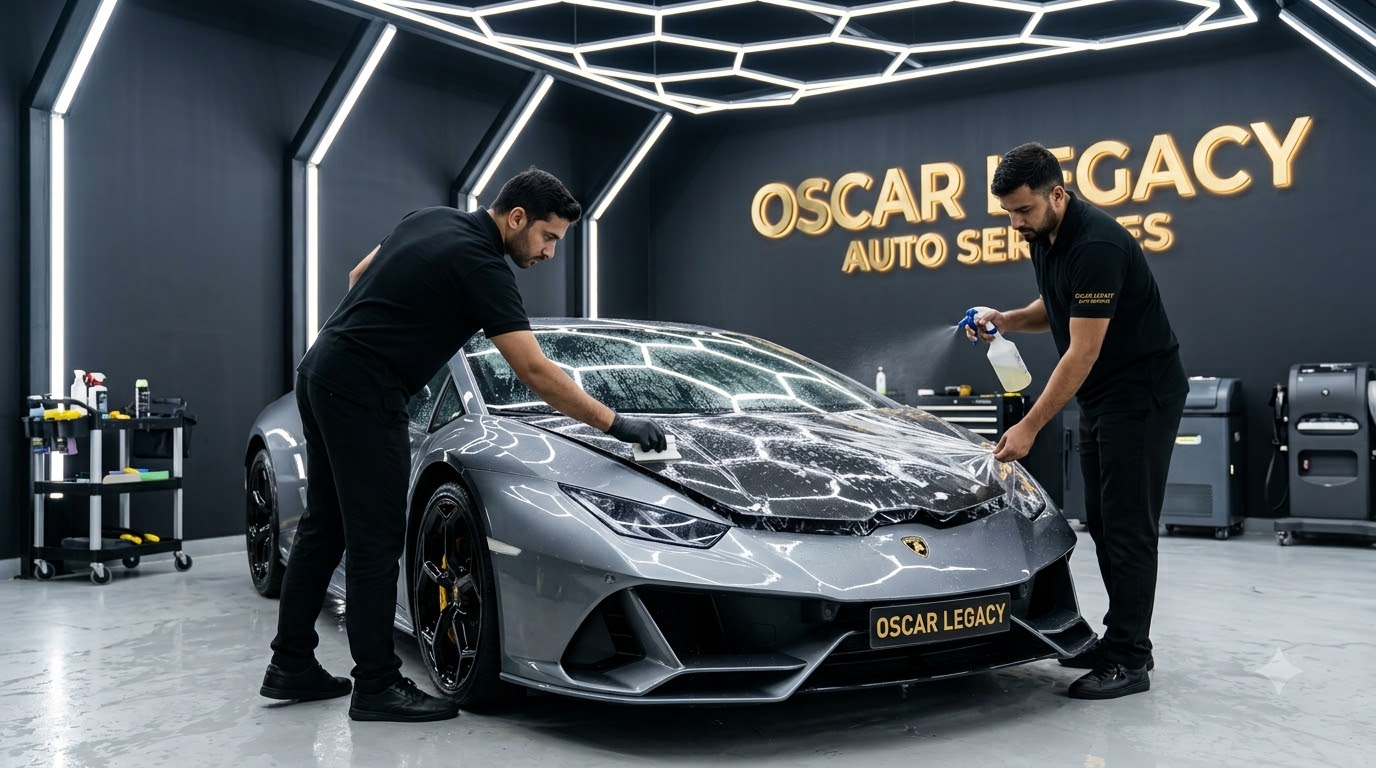
- Supercars and performance cars: If the vehicle regularly sees highway speeds on Sheikh Zayed Road or track days, the ultimate setup is PPF on high-impact zones (front bumper, full bonnet, mirrors, rocker panels) layered with a compatible ceramic or graphene coating on top. The TPU film absorbs impacts while the coating provides hydrophobic slickness and ease of cleaning.
8. Why the Installer Matters More Than the Label
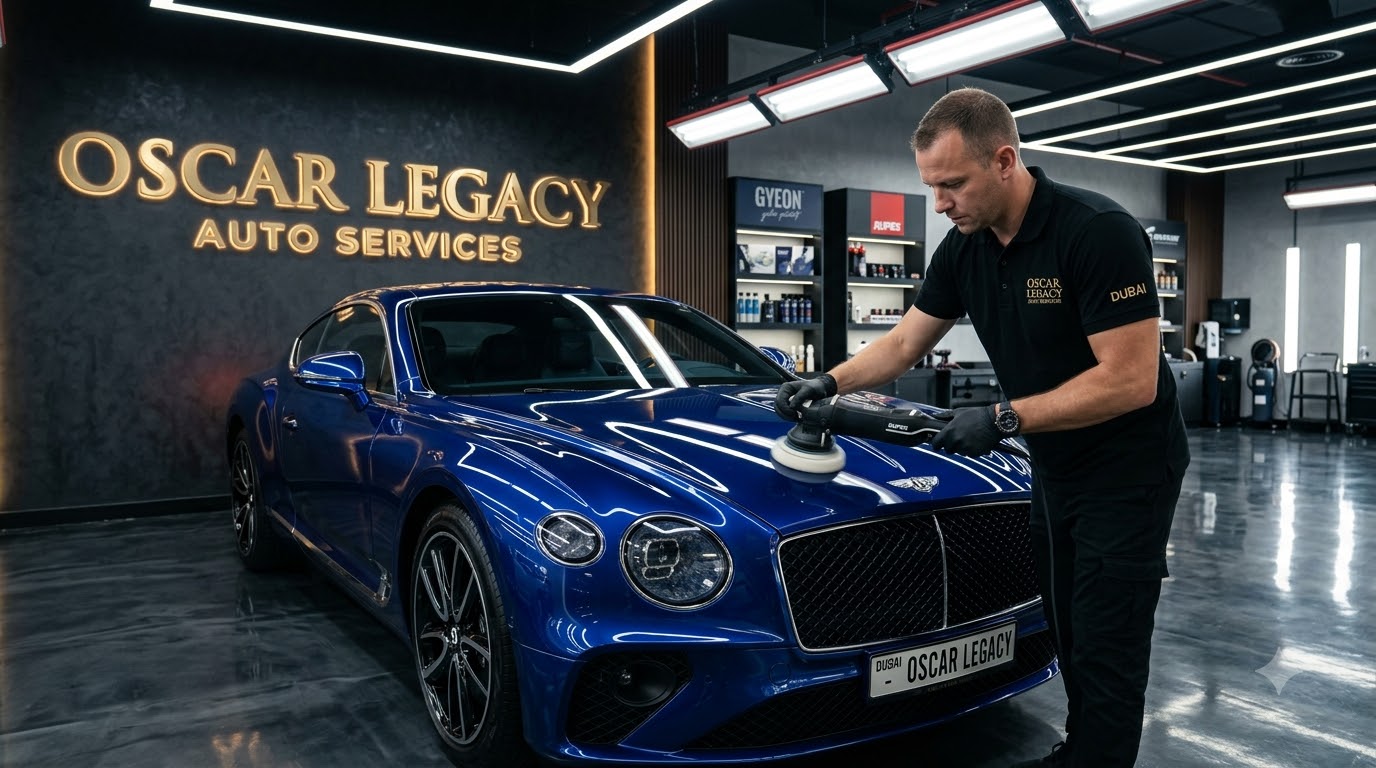
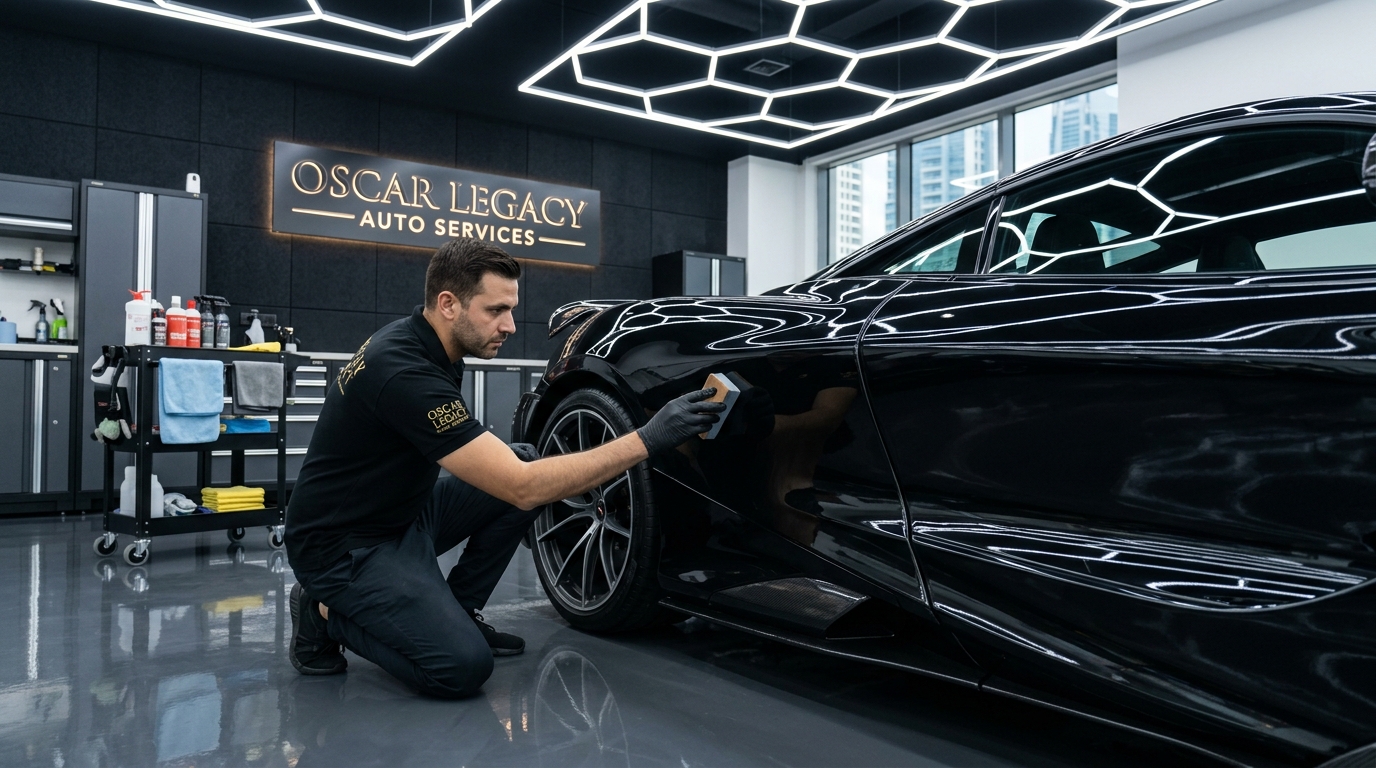
The best coating ever formulated will still fail on poorly prepared paint. Proper installation requires multi-stage paint inspection, thorough iron and tar decontamination, precision machine paint correction to eliminate existing defects, solvent degreasing, clean application, and infrared heat curing exactly to manufacturer specifications.
On a black supercar, high spots or swirls sealed beneath a coating will be far more noticeable than any chemical difference between graphene and ceramic. That's why the studio craftsmanship matters just as much as the bottle itself.
9. The Bottom Line
Graphene is an exciting development in automotive chemistry, and the underlying nanoscience is real. But coatings should be judged by proven results, not marketing buzzwords. For a vehicle in Dubai, the right coating is the one that stays glossy, resists chemical etching, survives extreme summer UV, and is straightforward to maintain. Sometimes that's an advanced graphene system; often, it's an expertly applied ceramic coating.
Protect Your Vehicle at Oscar Legacy Auto Services
We start by inspecting your vehicle's paintwork, analyzing your driving routine, and recommending the exact coating or PPF hybrid system engineered for Dubai's climate. Inquire today for a tailored consultation.
10. Frequently Asked Questions
Is graphene coating better than ceramic coating in Dubai?
Some graphene-enhanced formulas offer real improvements in surface behaviour or barrier performance. But not every graphene product beats a premium ceramic one. Testing, installation and maintenance decide the real-world result.
Will graphene coating keep my car cooler?
Pure graphene conducts heat exceptionally well, but that doesn't prove a finished coating will lower your paint temperature. That claim needs independent testing on the actual product.
Does a 10H graphene coating stop scratches?
No. No coating is scratch-proof. Neither graphene nor ceramic will stop deep scratches, stone chips or damage from sand caught in a wash mitt.
How long does graphene coating last in Dubai?
It depends on the product, the warranty terms, UV exposure, how the car is washed, where it's parked and how well it's maintained. Ask for durability information in writing rather than accepting "lifetime" promises.
Graphene coating or PPF: which should I choose?
They do different jobs. Coatings improve the surface: gloss, water behaviour and ease of cleaning. PPF is a thicker physical layer that absorbs impacts and abrasion. If the products are compatible, many owners use both.
Explore our bespoke ceramic and graphene coating solutions with Oscar Legacy Auto Services: precision, protection, and automotive excellence for Dubai's finest vehicles.