
Car Scratch Depth vs. Repair Viability
Look at a black car under petrol station lights at night and you'll see every swirl, every wash mark, every little scratch someone put there with a dirty towel. It's frustrating, especially on a car you paid a lot for. Most of those marks can be fixed, though. Some come out completely with polishing. Others can only be made less obvious. What decides which is which is how deep the scratch goes.
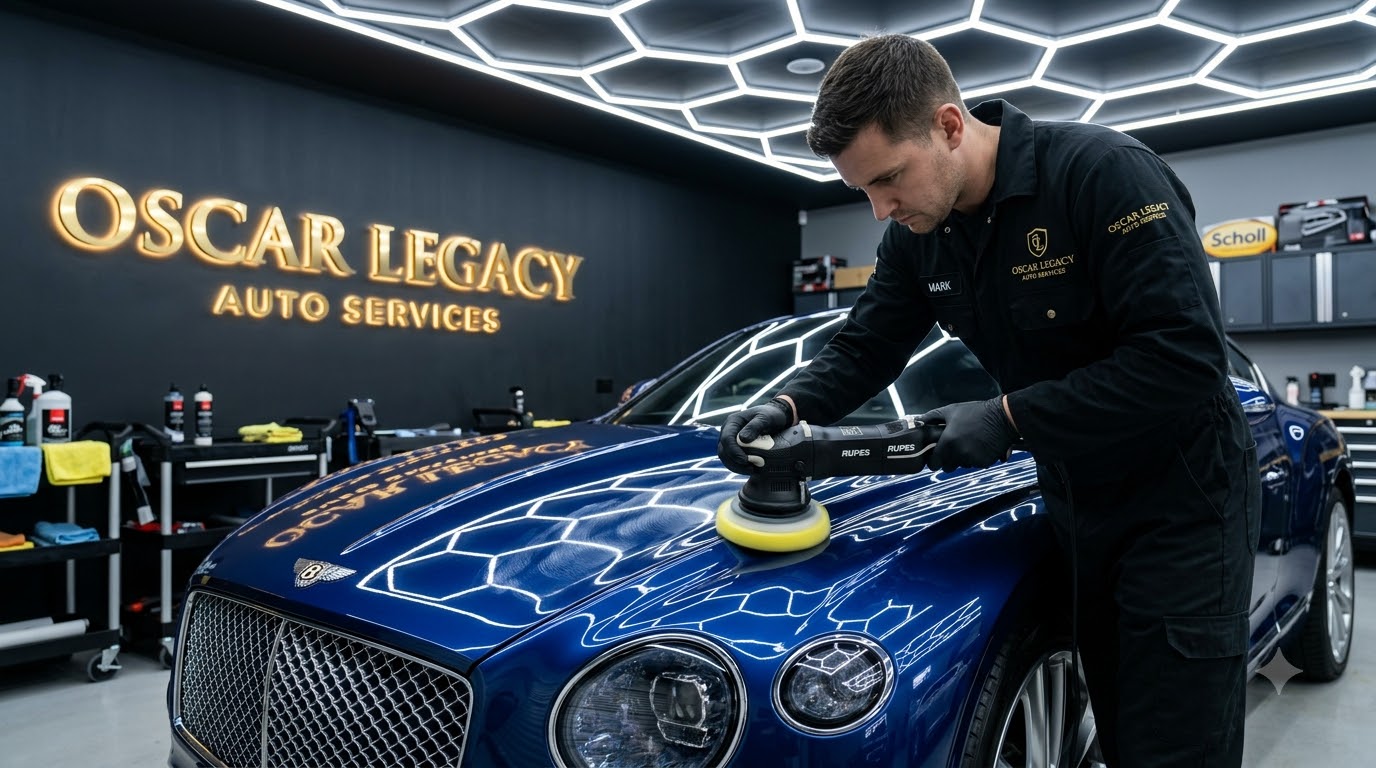
At Oscar Legacy Auto Services, we treat paint correction as careful, controlled work. We inspect the clear coat, refine it, and take off as little paint as we can along the way. If you're looking into paint correction in Dubai, it helps to understand how car paint is built up, because that tells you what can be corrected safely and what can't.
1. Clear Coat vs Base Coat: What's Actually on Your Car
Most modern cars have three main paint layers:
- Primer: Sits directly over the metal or composite body panel to prevent corrosion and provide adhesion.
- Base Coat: The middle colored layer that gives the vehicle its specific pigment, metallic flake, or pearl effect.
- Clear Coat: The transparent, hardened acrylic layer on top that provides high-gloss reflection and shields the paint from UV rays, atmospheric dust, and chemical fallouts.
Automotive paint systems from major manufacturers like 3M describe the layers in much the same way, with the clear coat being the primary sacrificial barrier exposed to the outside world.
Light scratches, wash marks, and swirls are nearly always in that clear coat. The colored base coat underneath is usually untouched. What has changed is the microscopic surface texture. A tiny scratch or groove scatters light in random directions instead of reflecting it cleanly, which is why a scratch can look white, grey, or cloudy even though the dark color beneath is completely intact.
Professional paint correction fixes this by leveling a microscopic amount of clear coat around the scratch. Once the surface is optically flat again, light reflects evenly and the mark fades or disappears entirely.
There is a hard physical limit: if the scratch has penetrated completely through the clear coat into the color or primer, there is nothing left to level. Polishing cannot put back paint that has already been sheared away.
2. Can Car Polish Remove Scratches?
We hear this question every day at our Dubai detailing studio. Yes, it can—as long as the scratch is shallow and confined to the clear coat.
A finishing polish will deal with fine swirls, light towel scratches, buffer haze, and mild oxidation in the clear coat. Heavier marks usually require a cutting compound first, followed by a finer polish to bring back crisp optical gloss. That is exactly what professional polishes are formulated for: minor scratches and swirls in clear coat finishes.
Once a scratch breaches into the color layer, polishing harder will not solve it. Pushing an aggressive rotary buffer on an already-compromised clear coat will only "burn through" to the primer, requiring an expensive respray.
This is also why a skilled master detailer never grabs the strongest compound on the shelf by default. Every pass with an abrasive pad removes a fraction of clear coat, and factory paint only gives you so much thickness to work with. The goal is always to achieve 100% defect removal with the gentlest combination of polish, pad, and machine that will safely execute the job.
3. The Fingernail Test for Scratch Depth
There is a reliable, time-tested tactile test to gauge scratch depth before booking workshop time:
Nail Slides Over (Shallow Defect)
If your clean fingernail slides across the scratch without catching or clicking into a groove, the damage is sitting entirely in the upper clear coat. Machine polishing and refining will have a 90% to 100% success rate in removing it.
Nail Catches (Deep Groove)
If your fingernail catches or drops into the groove, the scratch has penetrated deep into or through the clear coat. Polishing will round off the sharp edges to make it less visible, but complete removal requires micro-filling or spot repair.
Leading car care brands like Meguiar's give similar advice, emphasizing that any scratch deep enough to catch a fingernail requires professional assessment rather than over-the-counter consumer wax.
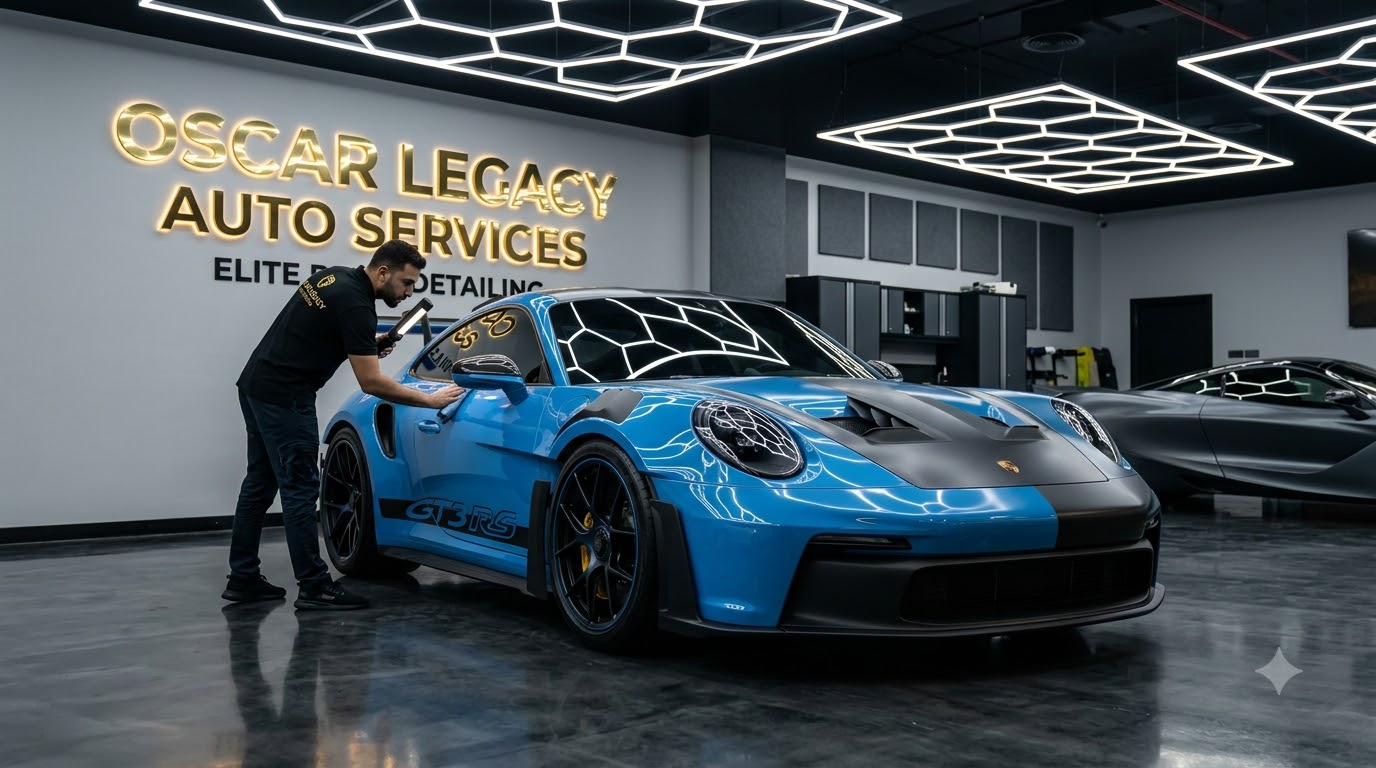
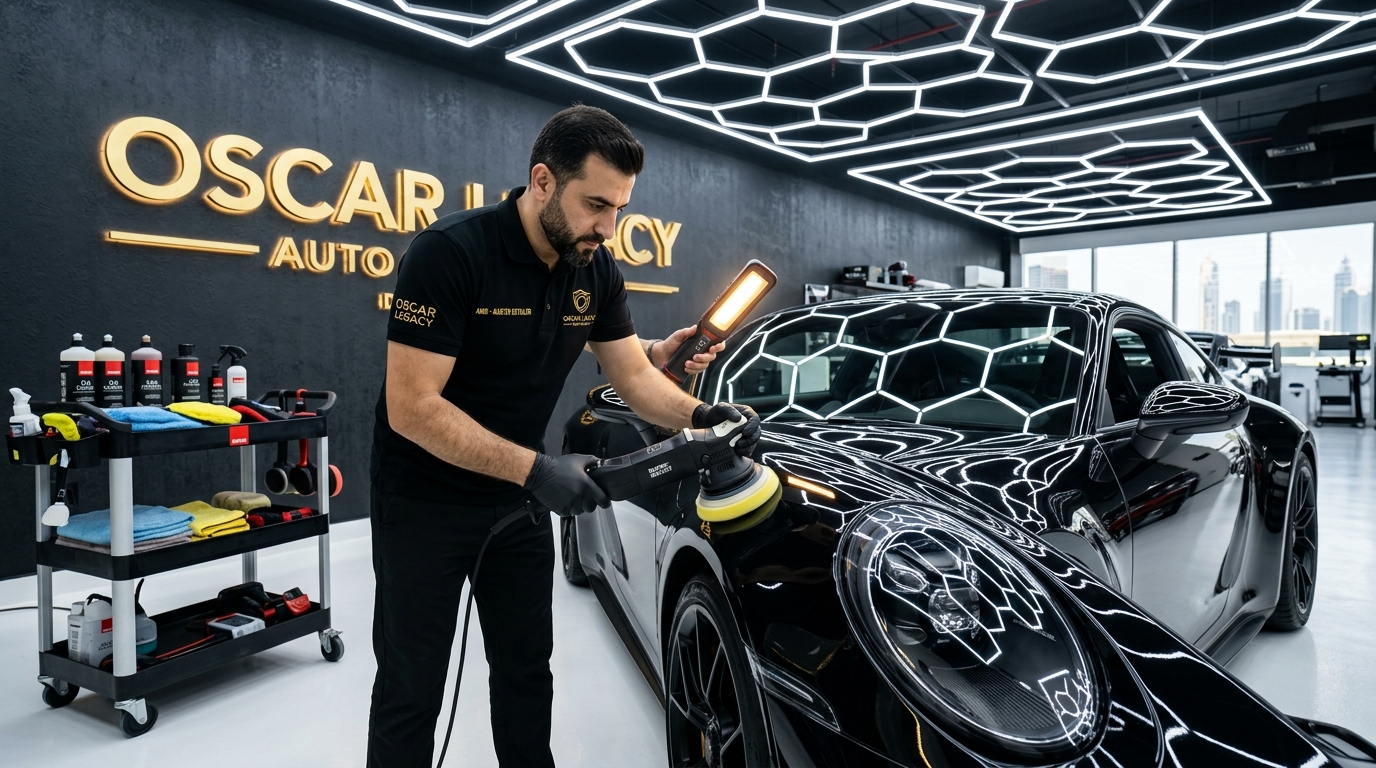
Treat the fingernail test as a helpful rule of thumb, not a full diagnosis. In our studio, our specialists assess clear coat health under high-CRI inspection lamps, utilize digital ultrasonic paint depth gauges to verify remaining clear coat thickness, and check for signs of previous bodywork or thin factory paint.
Oscar Legacy Studio Diagnostic: Clear Coat Thickness Rule
Digital Ultrasonic Gauge Readings on Modern OEM Vehicles
4. How to Remove Scratches from a Black Car
Black automotive paint hides nothing. Swirl marks, buffer holograms, towel trails, and microscopic compound haze that would remain invisible on silver or white vehicles stand out aggressively on black—particularly under direct Dubai sunlight or showroom spot lighting.
Correcting black luxury vehicles demands a meticulous, multi-phase workflow:
- Pre-Wash & Chemical Decontamination: Before any machine touches the paint, the car receives a touchless foam rinse, iron fallout chemical dissolution, and an ultra-fine clay bar treatment. Skipping decontamination means the polishing pad will grind sand particles into the paint, causing severe micro-marring.
- Test Spot Calibration: A master detailer tapes off a 40x40 cm section on a representative panel to test pad densities, compound abrasives, and machine speeds. Once the gentlest combination that clears defects without hazing is proven, that exact recipe is applied across the car.
- Multi-Step Refining: Moderate swirls on black paint require compounding followed by a medium refining polish. For sensitive, soft Japanese or German black clears, a third ultra-fine jeweling step with a soft finishing pad is mandatory to eliminate holograms and produce deep ink-like reflections.
5. Rotary vs Dual-Action (DA) Polisher
Two primary power machines perform professional automotive paint correction:
Rotary Polisher (Direct Drive)
Spins the pad on a single direct axis. In the hands of an experienced craftsman, it cuts rapidly and removes severe clear coat scratches and heavy sanding marks with supreme efficiency. However, because energy is concentrated in a direct rotational pattern, improper technique can build dangerous friction heat or leave visible rotary holograms.
Dual-Action (DA) Random Orbital
Spins the backing plate while simultaneously oscillating in an eccentric orbit. This dual movement mimics hand motions at 6,000+ oscillations per minute, distributing heat evenly across the panel and making concentrated burn-through or buffer trails virtually impossible.
Neither machine is universally better. At Oscar Legacy Auto Services, master detailers frequently use a high-torque rotary for initial heavy correction stages, and switch to large-throw DA polishers (such as Rupes BigFoot LHR21) for finishing and hologram-free clarity.
6. The Stages of Paint Correction
Depending on paint condition, thickness, and clear coat hardness, professional correction is categorized into dedicated stages:
- Single-Stage Correction: Uses an "all-in-one" medium polish or foam pad to remove 50% to 65% of light wash swirls, restoring clean gloss on well-maintained newer cars.
- Two-Stage Correction (The Luxury Standard): The first pass compounds the clear coat to eliminate 80% to 90% of medium scratches, water etching, and oxidation. The second pass refines the surface with a fine polish to remove haze and boost optical depth.
- Three-Stage / Concours Correction: Involves heavy compounding, medium refining, and an ultra-fine jeweling finish. Essential for black supercars, collector exotics, and heavily scratched dark clear coats.
3M's professional paint finishing process follows a similar methodical discipline: eliminate the primary defect, refine the secondary micro-scratches left behind, and complete with an ultra-fine swirl-free finish.
7. Why Touch-Up Pens Often Look Patchy
Touch-up paint pens are commonly purchased by vehicle owners when paint has chipped off to bare metal. However, applying a touch-up pen by hand almost never yields a seamless, invisible repair:
The Physical Limitations of Touch-Up Pens:
1. Layer Thickness Mismatch: Factory robots spray paint in microscopic, electrostatic layers measuring microns. A touch-up brush deposits liquid paint by hand, forming a raised blob that sits noticeably higher than the surrounding flat panel.
2. Flake Orientation: On metallic and pearl paints, aluminum flakes in sprayed paint settle horizontally. Hand-dabbed paint leaves flakes jumbled randomly, causing the touch-up spot to appear darker or mismatched under sunlight.
3. Sun Oxidation Shift: Even if you purchase the exact OEM color code, years of UAE UV exposure mean your existing paint has naturally shifted shade compared to fresh lacquer.
A superior repair for a deep scratch involves microscopic layer filling, wet sanding the raised ridge flat with 3000-grit abrasive paper, and machine polishing the repaired zone into the factory clear coat. Larger panel damage requires professional studio spot blending or respraying.
8. How to Avoid Swirl Marks on Car Paint in Dubai
Preventing scratches is infinitely easier and cheaper than correcting them. In Dubai's desert climate, 95% of clear coat swirl marks are created during improper hand washing:
- Never Dry-Wipe Dusty Paint: Airborne desert dust feels soft to the touch, but it consists of sharp quartz and mineral crystals. Wiping a dusty vehicle with a dry cloth or "duster" drags abrasive silica across the clear coat like sandpaper.
- Pre-Rinse with Snow Foam: Always soak the vehicle with pH-neutral snow foam and pressure-rinse thoroughly before any sponge or wash mitt touches the surface. This lifts and carries away loose road grime touchlessly.
- Use the Two-Bucket Wash Method: Dedicate one bucket to soapy water and a second bucket with grit guards for rinsing your wash mitt after each panel pass.
- Use High-GSM Microfiber Towels: Dry the vehicle with clean, plush 1000+ GSM microfiber drying towels or warm filtered air blowers. Never use old bath towels or dirty chamois leather.
9. Ceramic Coating & PPF After Paint Correction
Once your clear coat has been painstakingly corrected and leveled to flawless mirror clarity, it must be sealed and protected.
A professional nano-ceramic coating applies a semi-permanent, hydrophobic silicon dioxide (SiO2) shield over the clear coat. Water beads off instantly, road grime and bird lime struggle to bond, and maintenance washing becomes effortless.
However, ceramic coatings are not scratch-proof armor. Industry leaders like Gtechniq are transparent: coatings will not make automotive paint immune to rock chips, key scratches, or aggressive wash sponges.
Furthermore, correction must always precede ceramic coating. A ceramic coating acts like liquid glass—it cures over whatever paint condition exists underneath, permanently locking in swirls if applied prematurely.
For genuine, physical defense against Sheikh Zayed Road gravel and desert sandblasting, Paint Protection Film (PPF) on high-impact areas (front bumper, hood, fenders, side mirrors) is the ultimate safeguard. Applying a ceramic coating over the entire vehicle—including the PPF—delivers the pinnacle of stone-chip impact resistance and hydrophobic ease of care.
10. Paint Correction at Oscar Legacy Auto Services Dubai
Dubai roads are notoriously punishing on automotive paint. High-speed highway sandstorms, extreme 50°C summer UV indexes, and abrasive roadside car washes will degrade factory clear coats within months if left unaddressed.
At Oscar Legacy Auto Services, every vehicle begins with a rigorous diagnostic inspection in our cleanroom detailing studio. We map your car's paint thickness with digital gauges, isolate repairable clear coat scratches from base coat breaches, and craft a bespoke correction plan tailored to your vehicle's marques and paint type.
11. Side-by-Side: DIY Polish vs Oscar Legacy Paint Correction
| Factor | DIY Hand Polish / Pen | Oscar Legacy Studio Correction |
|---|---|---|
| Scratch Removal Rate | 20% - 35% (Temporarily fills swirls with oils) | 85% - 95%+ (Permanent clear coat leveling) |
| Paint Depth Assessment | Visual guess; high risk of burn-through | Digital ultrasonic clear coat depth gauge mapping |
| Equipment Used | Hand applicator pads or cheap rotary tool | Rupes BigFoot Dual-Action & Flex Rotary machines |
| Black Paint Holograms | Often creates cloudy buffer trails and haze | 100% hologram-free jeweling finish under inspection LEDs |
| Post-Repair Protection | Basic temporary wax (washes off in 2-3 weeks) | Multi-year ceramic coating or high-impact self-healing PPF |
| Resale Value Impact | Visible patchy touch-up marks reduce appraisal | Restores showroom gloss; maximizes private & trade-in value |
Have Scratches or Swirl Marks on Your Luxury Car?
Send our master detailers a clear photo of your car's scratch on WhatsApp. We will perform an instant digital paint assessment and provide a tailored restoration consultation.