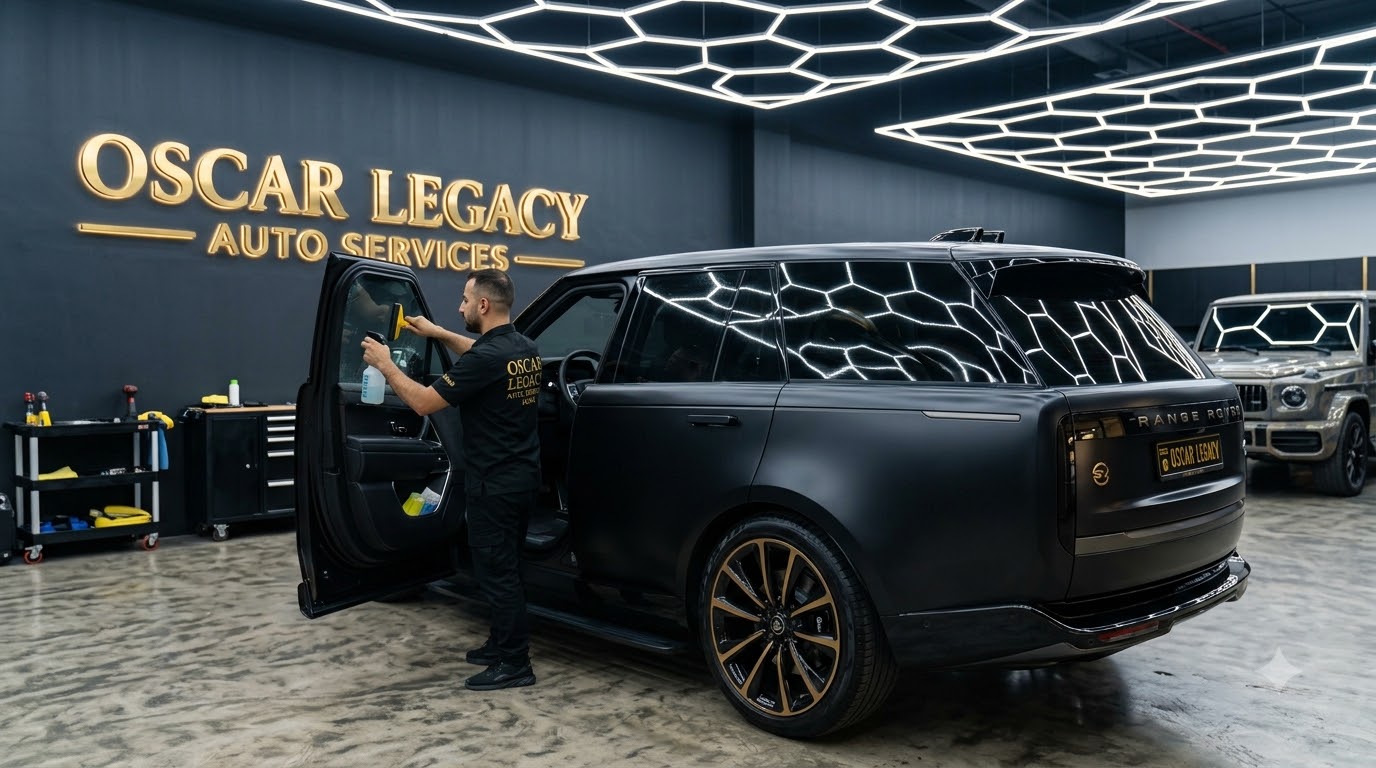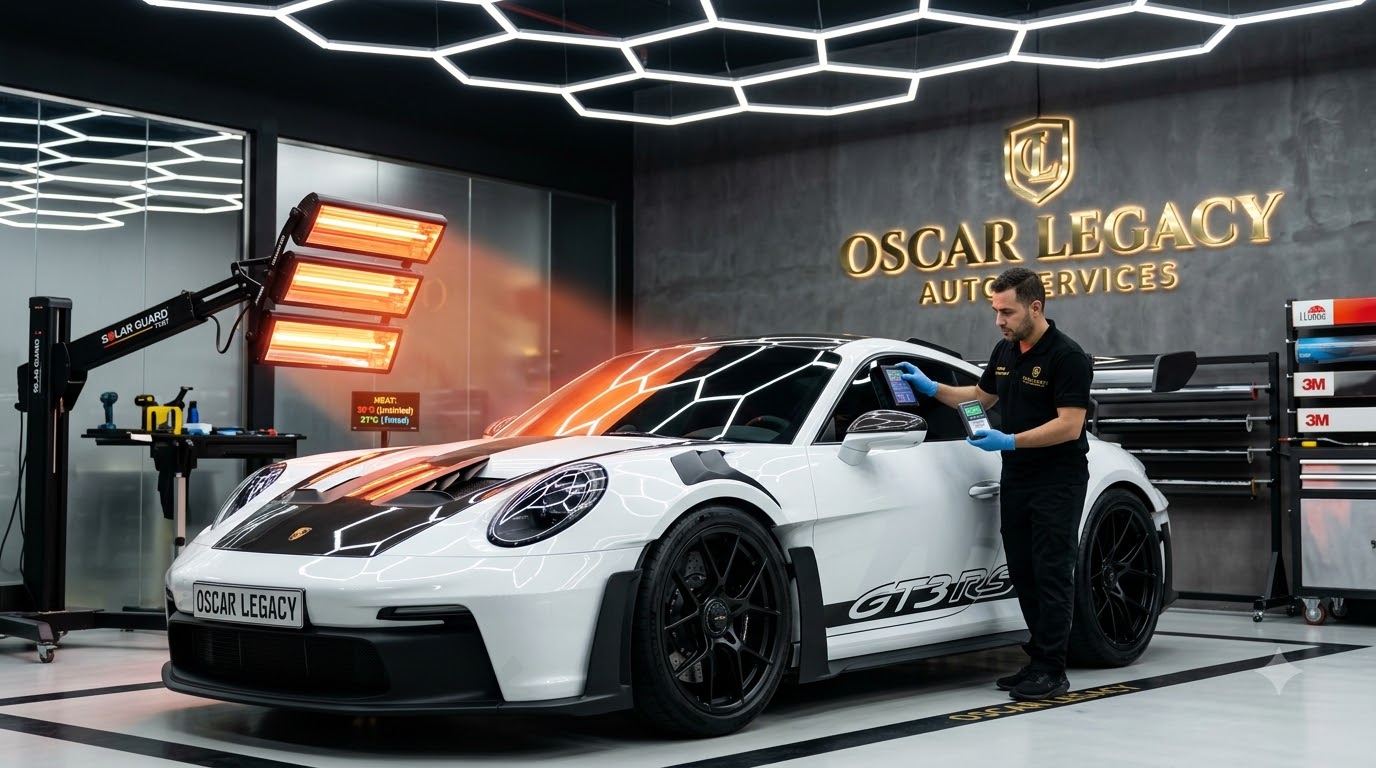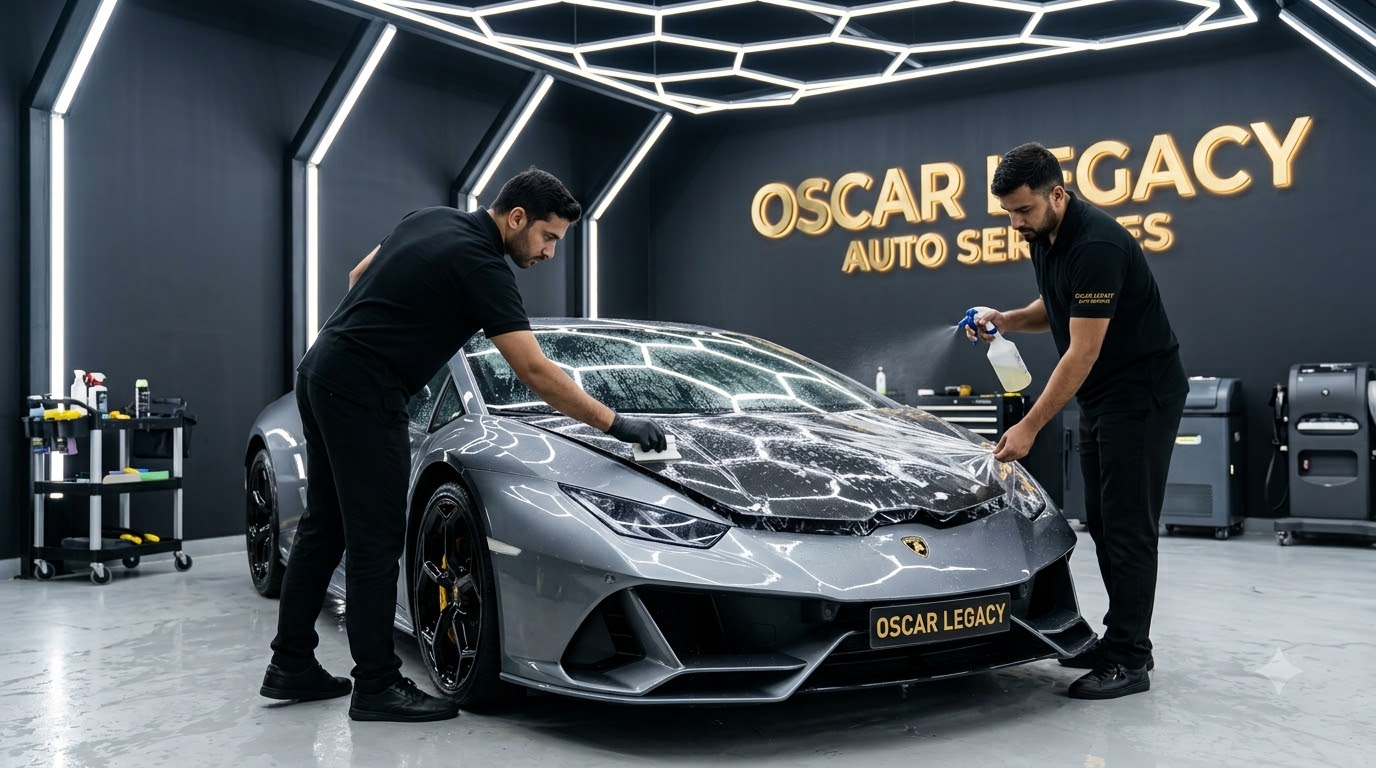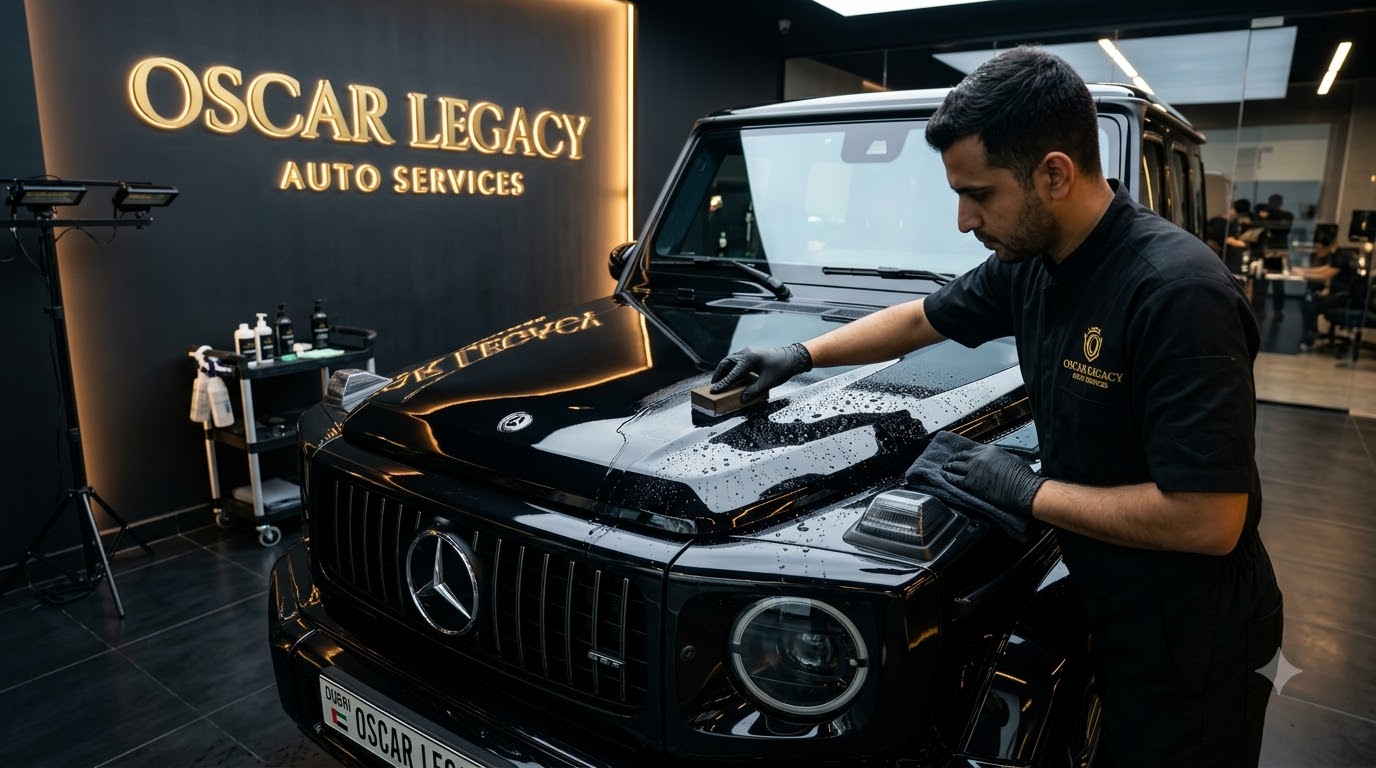
Picture a typical July afternoon in Dubai. You've parked outside since morning; opening the car door releases an oppressive wall of 65°C heat. The steering wheel burns your hands, the leather seats sting, and the climate control screams for ten minutes before the cabin becomes tolerable. Whether navigating Al Khail Road or Sheikh Zayed Road, the sun penetrates glass relentlessly. At Oscar Legacy Auto Services, we guide clients past marketing hype to the verified solar metrics that truly control cabin temperature: Infrared Rejection (IRR), Total Solar Energy Rejection (TSER), and Optical Clarity.
1. Why Does Your Car Turn Into an Oven?
Sunlight strikes automotive glass carrying three distinct energy forms: visible light (44% of solar energy), infrared radiation (53% of solar heat), and ultraviolet rays (3% causing interior fading and skin damage). When solar rays hit your dashboard, leather, and trim, those materials absorb the energy, heat up, and re-radiate long-wave infrared heat. Because closed automotive glass traps this radiant heat inside, the cabin temperature rapidly surges far above outside ambient levels.
2. How Infrared Heat Affects Your Driving Comfort
Even with air conditioning blowing maximum cold air, you've likely felt the scorching burn on your arm through an untinted side window. That is direct radiant heat. A specialized infrared-rejecting film cuts down this energy at the glass boundary, reducing skin burning, reducing dashboard thermal soak, cutting glare, and allowing your AC compressor to cycle efficiently.
3. What Is Carbon Window Tint?
Carbon tint embeds microscopic carbon particles within the polyester matrix. Unlike cheap dyed films that fade into an unsightly purple shade after one Dubai summer, carbon film retains an authentic matte charcoal appearance indefinitely. It provides solid privacy, zero wireless signal blockage, and moderate solar heat control at an accessible price point. However, carbon films cannot match the extreme infrared rejection achieved by nano-ceramic particles.
4. What Is Nano-Ceramic Window Tint?
Nano-ceramic window film utilizes sub-microscopic non-conductive, non-metallic ceramic particles engineered to selectively absorb and scatter infrared light. Crucially, ceramic technology decouples heat rejection from darkness: you can install a crystal-clear 50% or 70% VLT ceramic film that admits ample daylight while blocking more infrared heat than a pitch-black cheap dyed film. Furthermore, top-tier ceramic films provide >99% UV defense, crystal-clear optical clarity, and zero radio frequency interference.
Oscar Legacy Studio Diagnostic: Film Solar Physics
Engineering Solar Heat Rejection Standards for UAE Climate
5. Nano-Ceramic vs Carbon Tint: A TSER Benchmark Comparison
Total Solar Energy Rejection (TSER) represents the gold standard metric in film performance. Here is manufacturer-published lab benchmark data (tested on 6mm Auto 75 automotive glass):
| Film / Glass Specification | Visible Light Transmission (VLT) | Total Solar Energy Rejection (TSER) | Technology Class |
|---|---|---|---|
| Untinted Auto 75 Factory Glass | 73% | 42% | OEM Clear Glass |
| 3M Color Stable CS 35 | 32% | 55% | Nano-Carbon Matrix |
| 3M Ceramic IR 35 | 37% | 58% | Nano-Ceramic Nanotechnology |
| 3M Ceramic IR 50 (High Clarity) | 50% | 54% | High-VLT Nano-Ceramic |
Notice that Ceramic IR 35 lets in more light than CS 35 yet rejects more total solar energy. Furthermore, lighter Ceramic IR 50 nearly matches dark carbon in heat performance while maintaining superior nighttime visibility.
6. TSER vs IR Rejection: Why Film Marketing Confuses Buyers
Shops often advertise “99% Heat Rejection” by cherry-picking narrow-band Infrared Rejection (IRR) between 900nm–1000nm. True Infrared Energy Rejection (IRER) evaluates the entire 780nm–2500nm spectrum plus secondary interior re-radiation. Always demand audited TSER ratings rather than isolated IRR percentages.
7. Will Nano-Ceramic Affect GPS, Salik, or 5G Mobile Signal?
Traditional metallized tints block wireless signals by creating a Faraday cage effect. Both genuine premium carbon and nano-ceramic films installed at Oscar Legacy Auto Services are 100% non-metallized and dielectric, guaranteeing unimpeded operation for GPS navigation, 5G smartphones, keyless entry, radar detectors, and Salik toll RFID transponders.
8. Does Darker Tint Block More Heat?
No. Darkness (measured as Visible Light Transmission, or VLT) merely determines how much visible light passes through. A dark 20% dyed tint blocks glare but allows intense infrared heat to penetrate. In contrast, an advanced 50% or 70% nano-ceramic film stops massive thermal radiation without impairing night driving.
9. Carbon or Nano-Ceramic: Which Is Right for You?
Choose Carbon Tint If: You desire a stylish non-reflective dark charcoal appearance, reliable anti-fade longevity, and moderate heat relief on an economical budget.
Choose Nano-Ceramic If: You face heavy daily Dubai commutes, desire top-tier infrared relief, want maximum night-driving optical clarity, or need legal 50% shades that outperform darker economy tints.
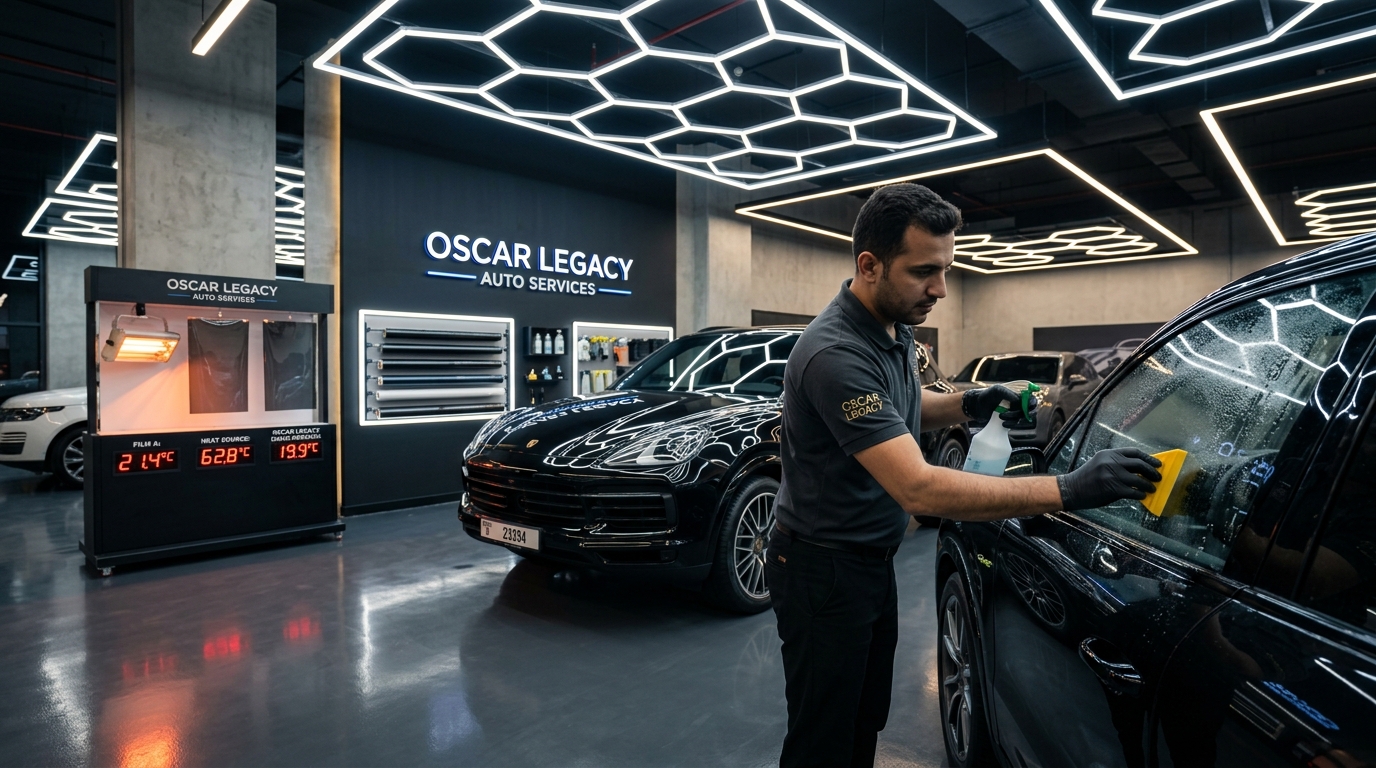
10. Try the Heat-Box Demo at Oscar Legacy Studio
Spec sheets are helpful, but feeling heat rejection firsthand is undeniable. Visit our Dubai studio to experience our interactive heat-box demonstration: place your hand behind untreated glass, carbon film, and premium nano-ceramic under a high-output 500W infrared solar lamp.
11. Dubai Tinting Costs & UAE 50% Legal Limits
Under UAE Federal Traffic regulations, eligible private passenger vehicles are permitted up to 50% tint darkness on side and rear windows, while the front windscreen must remain clear (with exception of legal top eyebrow strips or clear ceramic IR heat shields). Carbon packages typically range from AED 800–1,500, while premium multi-layer nano-ceramic installations range from AED 1,500–3,000+ depending on vehicle dimensions and window count.
Stop Battling the Heat. Experience Real Cabin Comfort.
Whether choosing reliable carbon or premium nano-ceramic, visit our studio for a live heat-box demonstration and bespoke quote tailored to your vehicle.
12. Frequently Asked Questions
Is nano-ceramic tint better than carbon tint for Dubai?
If maximum heat rejection is your priority, a high-performing nano-ceramic film is often the better choice. Good carbon tint can still do a great job for less money. Compare the actual products, not just the material names.
Can nano-ceramic tint block 95% of heat?
Some films advertise 95% or higher infrared rejection within certain wavelength ranges. That's not the same as blocking 95% of all solar energy. Look at TSER for the bigger picture.
Does ceramic tint work if it isn't very dark?
Yes. Some ceramic films reject a lot of solar energy even at fairly high VLT levels, so more light still comes through.
Will ceramic tint affect GPS or mobile reception?
Genuine non-metallised nano-ceramic films are designed not to interfere with common wireless signals, including GPS and mobile data.
Can nano-ceramic tint keep a parked car cool?
It reduces the solar heat coming through the tinted windows, but it can't stop a parked car from heating up. Cabin temperature also depends on sun exposure, ventilation, the roof, the bodywork and the weather.
Does carbon tint fade in Dubai?
Premium carbon films are made to hold their colour well. How they perform and how long they last still varies by brand, quality and installation.
How much does ceramic tinting cost in Dubai?
It depends on how much glass your car has, the film range, the installation work and the warranty. Send Oscar Legacy your car's details for a tailored quote.
Can I feel the difference before I choose?
Yes. Ask us about the heat-box demo at our studio, and use it alongside the published film data to make a more confident choice.
Bespoke automotive climate comfort at Oscar Legacy Auto Services: advanced solar nanotechnology engineered for the Dubai summer.