
Stone Chip Severity & Repair Strategy
From a few steps back, a stone chip looks like nothing. Get closer and it's a small crater in your paint. On Dubai and UAE roads, loose gravel and debris kicked up at highway speed hit the bonnet, bumper, front wings and mirrors hard enough to punch through the clear coat and the colour underneath. A light hit might stop at the primer. A harder one goes all the way down to bare metal.
That difference changes everything about the repair. A shallow chip might only need a careful dab of colour and clear coat. A chip down to metal needs proper sealing. And widespread damage on a premium car is usually a job for a professional.
So if you're looking into car paint chip repair in Dubai, the real question isn't just how to fill the mark. It's whether a DIY fix will actually look better, or whether it'll just draw more attention to the spot.
1. Why Dubai Driving Causes So Many Stone Chips
Stone chips are impact damage, plain and simple. Tyres pick up small stones, gravel and hard debris and throw them at the car in front, and at highway speeds on Sheikh Zayed Road (E11), Al Khail Road (E44), or the Dubai-Abu Dhabi highway, those little stones hit with bullet-like velocity. The front bumper, the leading edge of the bonnet, the front wings and the side mirror caps take most of it, with headlights and fog lamps sometimes caught too.
Dubai also brings its own extra problem: fine desert sand in the air. Sand is full of hard mineral particles, and if it gets dragged across the paint, especially when someone wipes a dusty car dry, it leaves tiny scratches. That's a different kind of damage from a rock chip, but put the two together and the front of a car starts looking tired and sandblasted surprisingly quickly.
2. Factory Paint Layers Anatomy
A stone can break through several layers of factory automotive finish:
If you can see grey or pale primer in the chip, the colour paint is gone but the body panel is still covered. If you see shiny metal, the stone has gone through the primer as well. On steel panels, bare metal is exposed to humidity and moisture, making prompt sealing essential to prevent localized rust bubbling.
Plastic composite bumpers will not rust, but chipped paint on them can still spread, flake at the edges, look scruffy, and eventually require panel repainting.
3. How to Repair Chipped Paint: The DIY Method
DIY works best on the odd small chip where the paint around it is still in good shape. The idea is to fill the tiny hole, not paint a patch around it:
- Clean the Panel Thoroughly: First, wash the panel properly and clean the chip itself of wax, grease and grime using isopropyl alcohol (IPA). Paint won't sit well on a dirty or oily surface.
- Determine Depth & Prime if Metal is Bare: If you can see bare metal, put down a suitable automotive etching primer before any colour. If the factory primer is still intact, you probably don't need additional primer.
- Extract Your Exact OEM Paint Code: Obtain touch-up lacquer formulated strictly to your car's exact paint code. This is especially vital on metallic, pearl, and multi-stage paints, where something that looks acceptable in the bottle can look jarringly wrong once you step out into Dubai sunlight.
- Ditch the Bottle Brush for Micro-Applicators: Don't use the thick, clumsy brush that comes attached to the bottle lid. Use a micro-brush, toothpick, or fine 00-gauge artist brush. Place a microscopic droplet inside the crater and build it up slowly. A few thin layers almost always look neater than one heavy dab.
- Cap with Clear Lacquer: When the color has dried according to manufacturer specs, add a compatible clear lacquer on top. This restores gloss and seals the color pigment.
Don't worry if it doesn't look completely flat straight away. A well-filled chip often sits slightly proud of the surrounding clear coat at first. That raised ridge can sometimes be leveled later on.
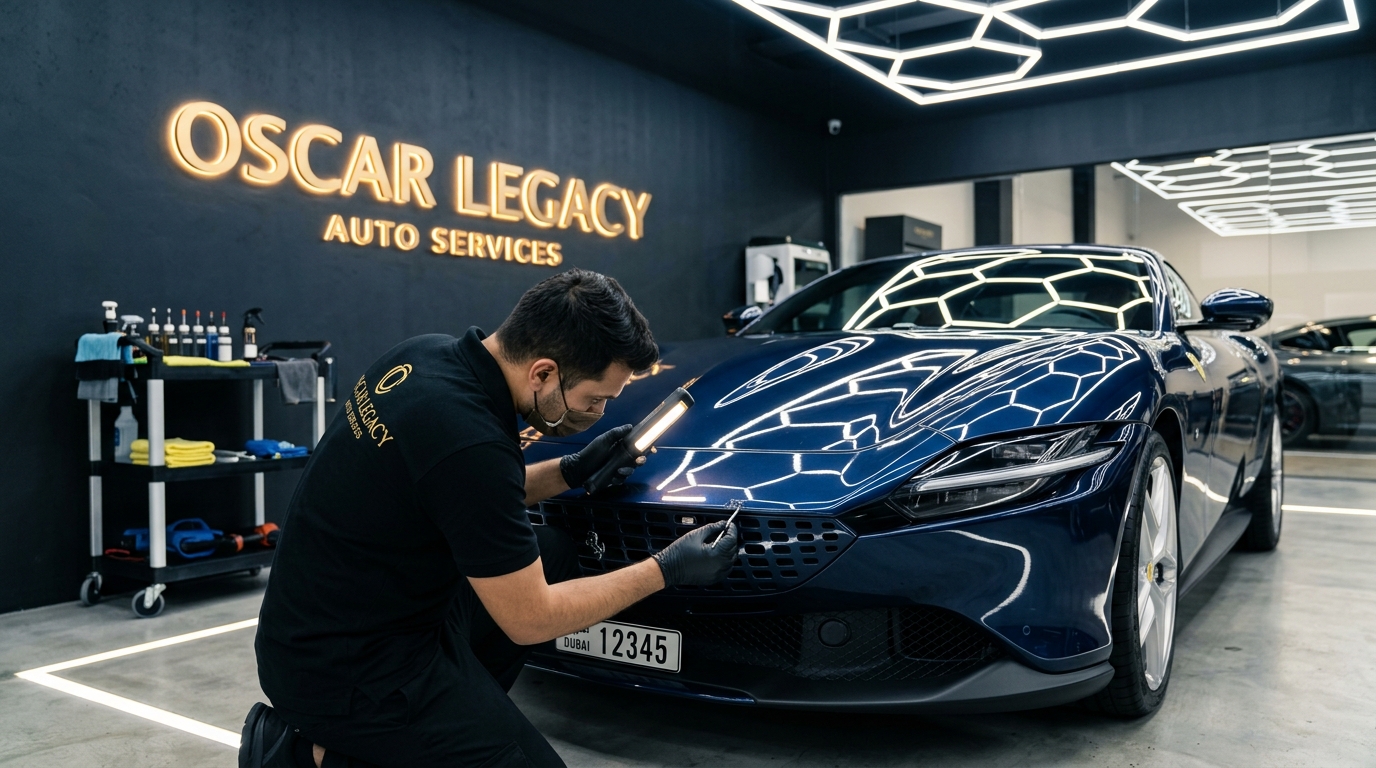
Oscar Legacy Diagnostic: Stone Chip Severity & Penetration Depth
Cleanroom Micro-Inspection Guide for Supercars & Luxury Vehicles
4. The Extreme Risks of Wet Sanding
This is the point where DIY stone chip repair starts getting genuinely risky.
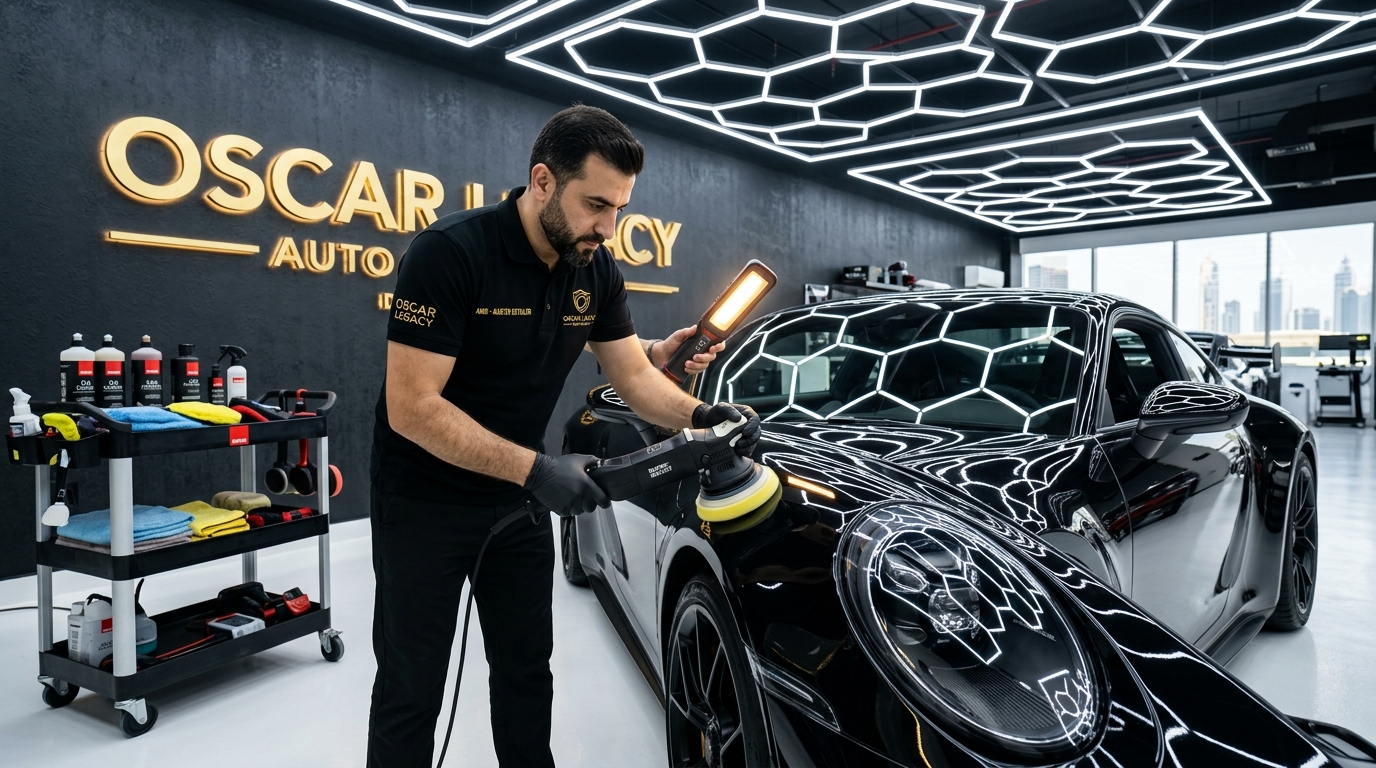
Once touch-up paint and clear coat are fully cured, an experienced detailer may use ultra-fine wet-and-dry paper (typically 2,000 to 3,000 grit) to gently flatten the raised repair, followed by machine polishing to bring the mirror shine back.
⚠️ Why Wet Sanding Can Destroy Factory Clear Coat:
You are only trying to shave off the microscopic fraction of touch-up paint sitting above the original surface. However, factory clear coat on modern cars is only 35 to 45 microns thick—about the thickness of a post-it note!
Sand a fraction too aggressively or apply uneven pressure, and you will cut through the factory clear coat into the color base coat ("burn-through"). Once that happens, no polish can fix it, and the entire panel must be stripped and resprayed. Panel edges, creases, and body contours are particularly dangerous because factory paint is naturally thinner there.
Therefore: filling small chips with a micro-brush is a reasonable DIY project; wet sanding and blending the repair into the clear coat are advanced paint correction disciplines that belong in a controlled detailing studio.
5. DIY vs Professional Stone Chip Repair in the UAE
| Driving Situation / Damage Level | DIY Touch-Up Viability | Professional Studio Repair |
|---|---|---|
| One or two tiny chips | Usually Fine (Neat micro-touch up) | Optional (Can combine with maintenance detail) |
| Primer visible in crater | Doable with Care (Requires primer coat) | Recommended if you want it near-invisible |
| Bare metal showing on steel panel | Doable with proper prep & anti-rust etching | Recommended (Guarantees corrosion defense) |
| Dozens of chips peppered across bonnet | Hard to Blend (Looks patchy and dotted) | Recommended (Micro-leveling or panel blend) |
| Metallic or pearl multi-layer paint | Color match & flake orientation can be tricky | Recommended (Precise optical blending) |
| Supercar or luxury exotic vehicle | High risk of visible repair depreciating resale | Strongly Recommended (Preserves provenance) |
| Large chip with flaking clear coat | Not a Good DIY Job | Professional Spot Repair |
| Wet sanding required to level repair | Advanced DIY only (Severe burn-through risk) | Studio Cleanroom Standard |
The fundamental difference between the two approaches is the finish quality. A DIY fix is mostly about covering the exposed spot so it doesn't rust. Professional stone chip repair in Dubai controls paint thickness, digital color match, wet-sanding leveling, and jewel polishing so the repair blends seamlessly into surrounding paint.
6. Why Touch-Up Paint for Luxury Cars Demands Precision
Searching online for touch-up paint for luxury cars makes it sound like a quick five-minute fix, but premium automotive paint is significantly harder to work with, not easier.
High-end marques use complex metallic flakes, multi-stage pearls, tinted clear coats, or matte finishes. How those pigment layers sit, and how thick they are, changes how the color looks from different angles under Dubai sun. Even touch-up paint mixed with the exact OEM code can stand out as an unsightly dark blob if too much paint is deposited into the chip.
There is also much more at stake. On a Ferrari, Porsche, Bentley, Range Rover, Mercedes-AMG, or BMW M car, preserving original factory paint directly influences both aesthetic pride and trade-in resale value.
On these vehicles, professional micro touch-up is usually the superior route when there are multiple chips or when the damage sits on the prominent center of the bonnet. The primary goal must always be to preserve as much original factory paint as possible, rather than repainting an entire panel over a few small marks.
7. When a Stone Chip Needs Professional Repair
It is time to bring your car into a certified detailing studio when:
- The chip is larger than 3 mm across.
- Corrosion or orange rust spots have started forming on exposed metal.
- Several paint layers have cracked in an impact starburst pattern.
- Clear coat around the chip is delaminating or lifting at the perimeter.
- A single panel has dozens of peppered hits from high-speed highway driving.
- Your vehicle has a satin, matte, or frozen factory finish (which cannot be polished or blended with conventional gloss methods).
One critical point must be understood: polishing alone cannot fix a stone chip. Paint correction works by leveling microscopic clear coat around a scratch. A stone chip is paint that is physically missing—it must be micro-filled or refinished.
8. Rock Chip Prevention: Why Front PPF Makes Sense in Dubai
Once your stone chips are repaired, stopping the next barrage of gravel is far smarter than touching up paint over and over again.
That is where Paint Protection Film (PPF) earns its keep.
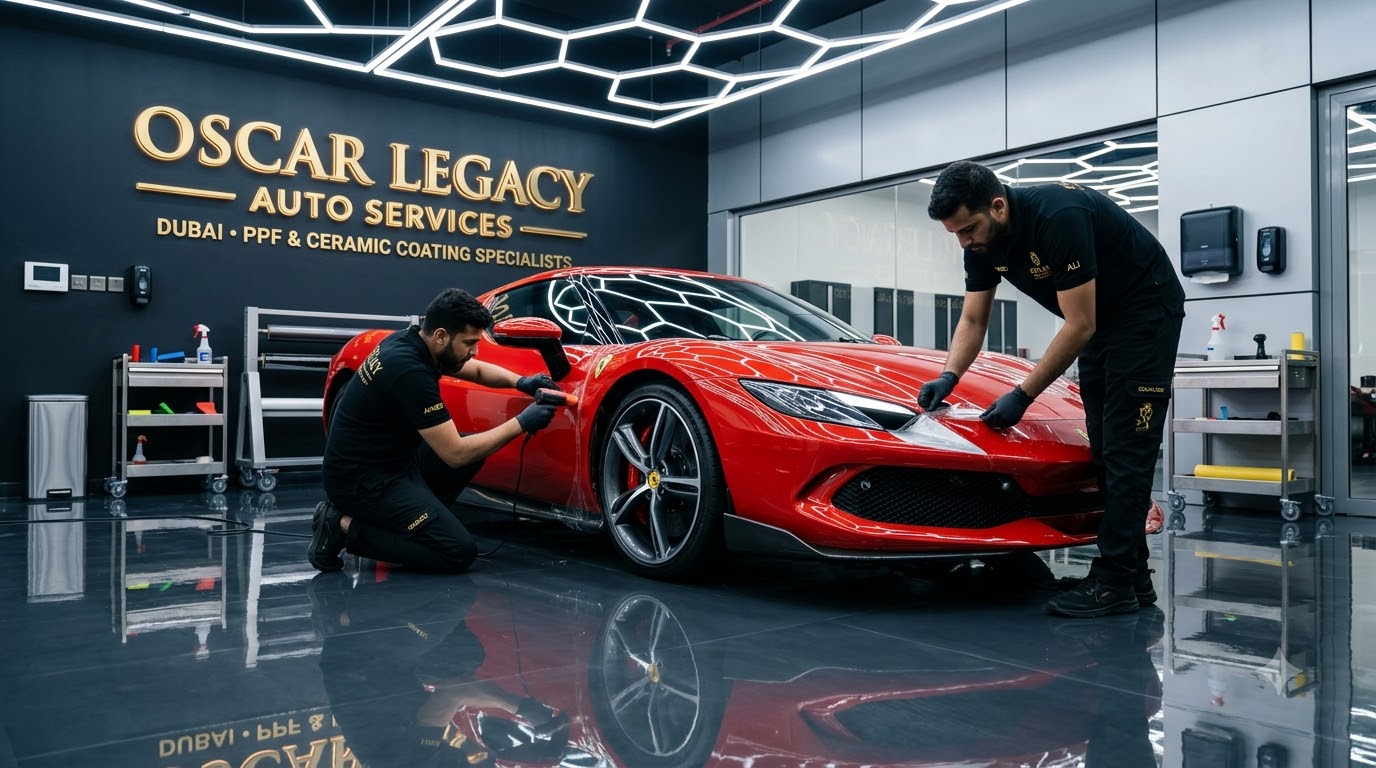
PPF is an optically clear, high-durability aliphatic thermoplastic polyurethane (TPU) film applied directly over the paint. Automotive film leaders like 3M, XPEL, and SunTek engineer these films specifically to absorb high-velocity gravel impacts, stone chips, road debris, and abrasive sandblasting without letting damage reach the underlying clear coat.
For UAE driving, the coverage package that makes the single biggest difference is Full Front PPF:
- Full front bumper & lower splitters
- Complete bonnet (leading edge to cowl)
- Both front wings (fenders)
- Side mirror caps
- Headlights & daytime running lights
To be completely clear: when Dubai car specialists describe front PPF as "mandatory," it does not mean there is a legal government requirement in the UAE. There isn't. But if you own a luxury vehicle, or have just invested in paint correction, and want your front end to stay in showroom condition, front PPF is as close to essential protection as automotive care gets.
Ceramic coatings are fantastic for hydrophobicity, water beading, chemical resistance, and effortless washing. However, they are micro-thin (1–2 microns) liquid sealants—they will not stop flying gravel. Only physical TPU film stops stone chips.
9. Repair First, Then Protect with Film
Paint protection film should never be installed over untreated, chipped paint.
Before fitting PPF, the front end must be scrutinized under high-CRI inspection lights. Existing chips must be chemically decontaminated, cleaned of wax, and micro-filled. Raised touch-up ridges must be carefully leveled where safe, and the paint machine-polished to mirror gloss before film application.
This ensures the paint beneath the film is immaculate, and prevents old stone chips from being sealed beneath clear TPU where you will see them every day.
10. Final Verdict: DIY or Professional Studio?
If you are deciding how to repair chipped paint on your vehicle in Dubai, it comes down to three factors: chip size and depth, paint complexity, and your required standard of perfection.
A small, isolated chip can often be improved with careful DIY micro-filling using matched OEM paint and clear lacquer. But once you are dealing with wet sanding, metallic flake blending, bare steel, or dozens of highway chips, professional studio restoration is the safe, guaranteed route.
For luxury cars in Dubai, prevention is the ultimate strategy. Repair existing chips properly to preserve factory paint provenance, and install high-grade TPU PPF on high-impact front panels. Do that, and your bonnet, bumper, and fenders will look showroom-fresh, whatever Sheikh Zayed Road throws at them.
Have Stone Chips on Your Luxury Car's Bonnet or Bumper?
Send our master detailers clear photos of your vehicle's stone chips on WhatsApp. We will assess the depth, verify paint code availability, and provide an instant repair consultation.