Executive Summary: The Thermal Assault on Automotive Cabins
Open your car door after parking outside in Dubai during midday, and you will feel the intense thermal reality immediately: an enclosed vehicle cabin regularly reaches 70°C to 80°C, with dashboard surfaces exceeding 95°C under direct solar radiation. Automotive leather is an organic material treated with natural tanning oils and plasticizers; extreme radiant heat leaches these lubricants out, causing hides to stiffen, shrink, and crack, while melting headliner foam adhesives into sticky residue.
Surface bolster scuffs and dye wear can be seamlessly restored with micro-fillers and OEM pigment matching at 20% the cost of replacement.
Automotive Full-Grain and Nappa leather excel with quarterly conditioning; Alcantara requires oil-free maintenance, while low-grade PVC peels rapidly.
A saggy, creased seat cover is almost always caused by collapsed internal polyurethane cushion foam underneath, which must be rebuilt first.
What Luxury Automotive Upholstery Actually Encompasses
Many vehicle owners equate upholstery solely with seat covers. However, inside a high-end luxury sedan, grand tourer, or exotic supercar, the cabin upholstery represents a multi-layered architectural ecosystem consisting of:
1. Seats & Bolster Architecture
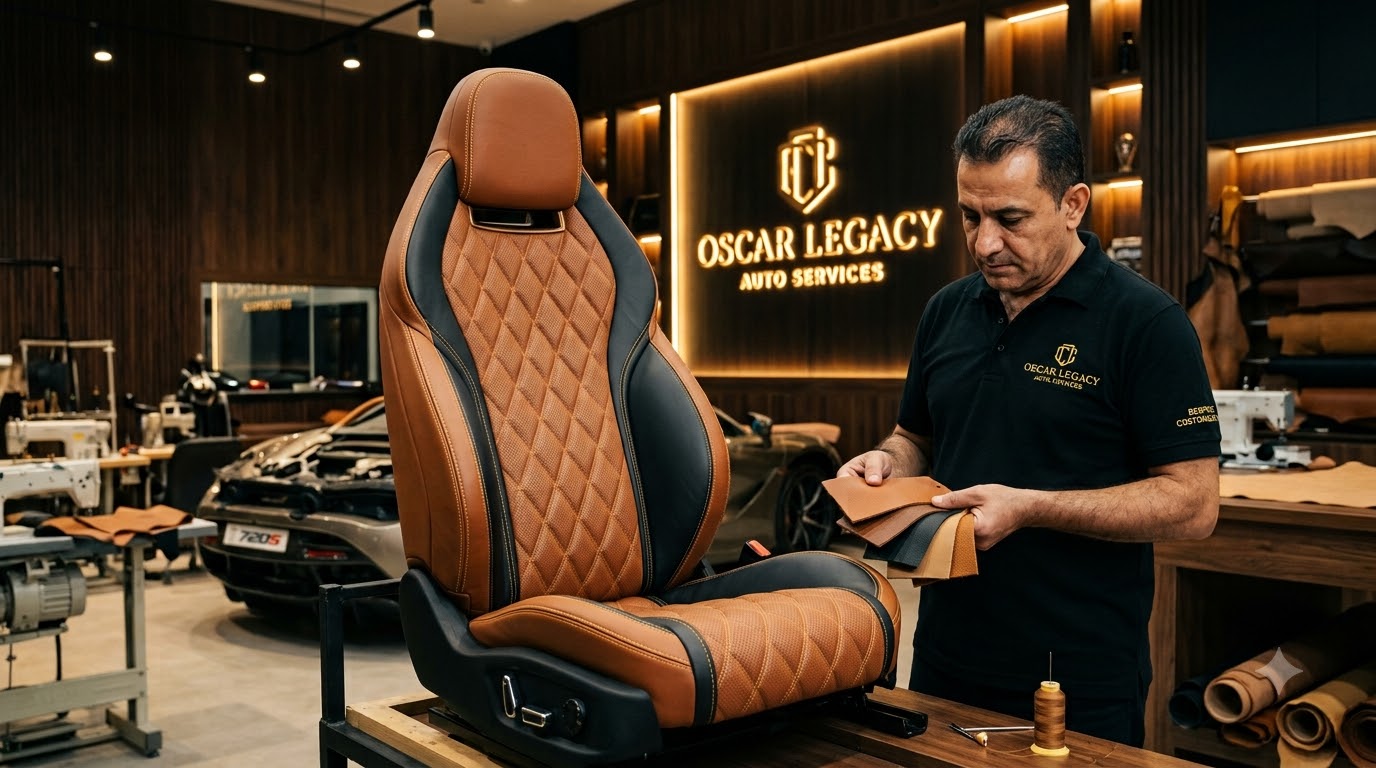
Thigh extensions, side support bolsters, headrests, rear bench, and ventilated perforated center inserts featuring diamond quilting or custom embroidery.
2. Steering Wheel & Control Contact Points
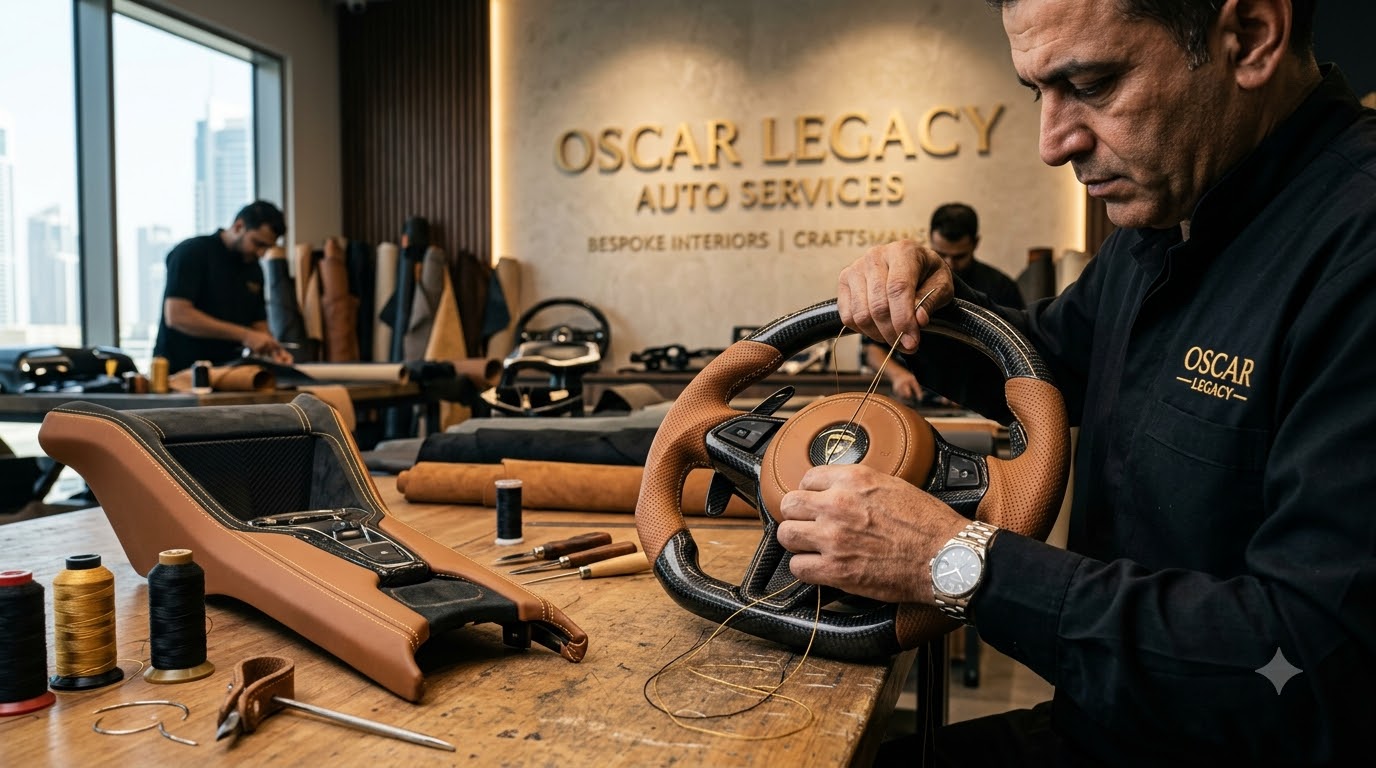
The most frequently handled surface in the vehicle. Re-covered in hand-stitched Nappa leather or Italian Alcantara with contrasting 12 o'clock racing stripes.
3. Headliners, Pillars & Starlight Canopies
A, B, and C pillar trim panels, sun visors, rear parcel shelf, and sagging headliner restoration with high-temperature aerospace contact adhesives.
4. Door Cards & Center Console Panels
Armrest lids, transmission tunnel trims, door handles, and lower kick panels lined with scuff-resistant materials matched to factory color codes.
Automotive Materials Honestly Evaluated for Dubai's Climate
Selecting the correct hide or textile determines whether your bespoke cabin looks showroom-fresh five years from now or deteriorates into stiff, faded disrepair:
Full-Grain & Nappa Leather
Sourced from top-tier European hides, Nappa leather delivers an exceptionally soft, silky tactile feel with minimal artificial pigmentation.
- Pros: Sublime comfort, ages gracefully with conditioning, can be seamlessly re-dyed.
- Cons: Thinner hide requires quarterly conditioning against Dubai heat dryness.
Genuine Italian Alcantara
A synthetic composite microfibre made of 68% polyester and 32% polyurethane, renowned for grip and anti-glare properties on supercars.
- Pros: Remains cool in summer, zero dashboard reflection, aggressive tactile grip.
- Cons: Absorbs hand sweat and sebum; requires soft-brush dry cleaning to prevent shine.
Automotive Polyurethane (Vegan)
Engineered modern synthetics (MB-Tex, Sensafin, Veganza) engineered specifically to withstand relentless UV radiation and spill stains.
- Pros: Zero drying out, impervious to sunscreen stains, wipes clean with a damp towel.
- Cons: Lacks the organic aroma and breathability of authentic calfskin leather.
Master Saddlery & Foam Reconstruction
At Oscar Legacy Auto Services, we do not simply wrap new material over degraded foundations. Every seat undergoes de-skinning, steam injection to expand tired high-density foam, and laser-guided stitching with UV-stabilized German Serafil threads that will never rot under intense UAE sunshine.
- Original factory hog-ring tensioning for zero loose wrinkles
- Certified OEM airbag break-away seam testing for passenger safety
- Perforated laser patterns engineered for factory seat ventilation systems
Repair vs. Retrim: Decision Matrix & Dubai Cost Guide
Many vehicle owners assume that cracked leather necessitates an expensive total retrim. In reality, modern leather surgery techniques allow specialized ateliers to preserve original hides whenever structural integrity remains intact:
| Damage Type | Recommended Solution | Typical Turnaround | Approximate Dubai Cost | Expected Lifespan |
|---|---|---|---|---|
| Outer Bolster Scuff & Color Loss | Deep degrease, flexible micro-filler, computerized pigment recoloring & matte clear topcoat | 1 Day | Inquire on WhatsApp → | 3 – 5 Years with conditioning |
| Torn Leather or Split Seam | Single-panel replacement or precision restitching with Serafil high-tensile thread | 1 – 2 Days | Inquire on WhatsApp → | Matches factory durability |
| Collapsed Cushion Foam & Creasing | Seat de-skinning, high-density orthopedic foam rebuild & hog-ring re-tensioning | 1 – 2 Days | Inquire on WhatsApp → | 5+ Years |
| Sagging Roof Headliner | Removal of board, stripping dead foam, re-wrapping with heat-resistant foam-backed fabric/Alcantara | 2 – 3 Days | Inquire on WhatsApp → | 5 – 8 Years (High-temp adhesive) |
| Steering Wheel Shine & Leather Peel | Full wheel strip, re-trim in smooth Nappa or Alcantara with custom color center stripe | 1 Day | Inquire on WhatsApp → | 4 – 6 Years |
| Full Cabin Bespoke Retrim (Front & Rear) | Complete bespoke transformation in imported Italian Nappa leather, custom stitch & door cards | 5 – 8 Days | Inquire on WhatsApp → | Lifetime with proper care |
The Anatomy of Headliner Sagging in the Middle East
A drooping headliner is practically an automotive epidemic across the Gulf region. Understanding why it happens prevents owners from wasting money on ineffective DIY fixes:
Why Re-Spraying Glue Never Works
Factory headliner fabric is not glued directly to the roof shell; it is laminated onto a 3mm open-cell polyurethane foam layer that sits against a fiberglass backer board. When summer cabin heat hovers near 80°C, the foam chemically breaks down into an orange powdery crumb. The glue did not fail—the foam itself disintegrated. Injecting glue through pins simply creates ugly stains on ruined foam. The entire headboard must be removed, scraped to bare substrate, and relaminated with fresh foam-backed textiles using heat-stable thermoset adhesives rated to 120°C.
Why Entrust Your Vehicle to Oscar Legacy Auto Services
Prestige marques require saddlers who respect original craftsmanship standards. At Oscar Legacy Auto Services in Dubai, our bespoke interior atelier provides:
- Direct European Hide Sourcing: Genuine automotive leathers imported from renowned tanneries in Germany, Italy, and the UK with certified OEM grain matching.
- OEM Airbag Integrity Guarantee: We utilize computerized sewing machines configured with burst-calibrated threads, ensuring seat-mounted side airbags deploy without impediment.
- Climate-Engineered Adhesives: All bonding agents used on headliners, dashboards, and door cards are formulated to withstand extreme radiant UAE heat up to 130°C.
Frequently Asked Questions
Rejuvenate Your Vehicle's Cabin to Showroom Perfection
Whether restoring cracked bolsters, curing a sagging headliner, or crafting a bespoke full Nappa interior with contrast diamond quilting, Oscar Legacy Auto Services delivers perfection. Visit our Dubai atelier or contact our master saddlers today.