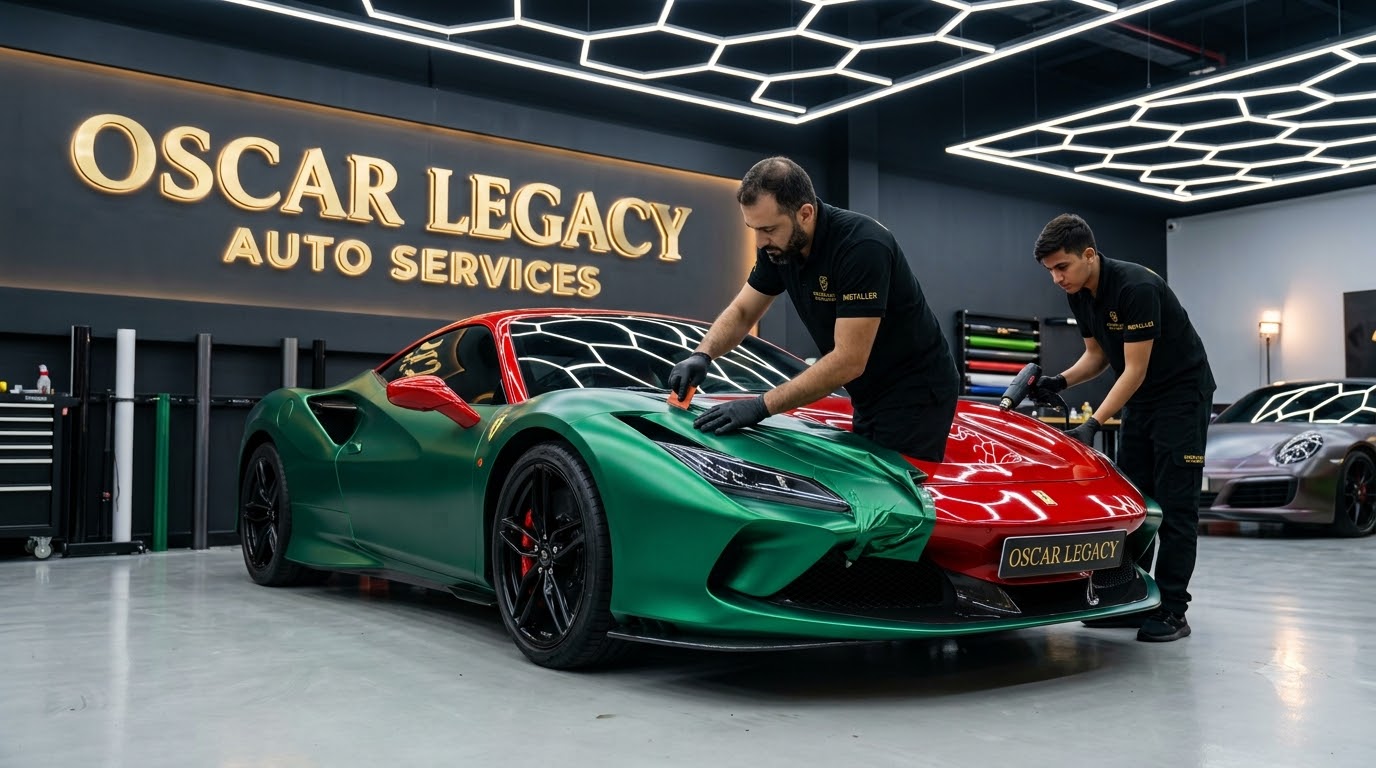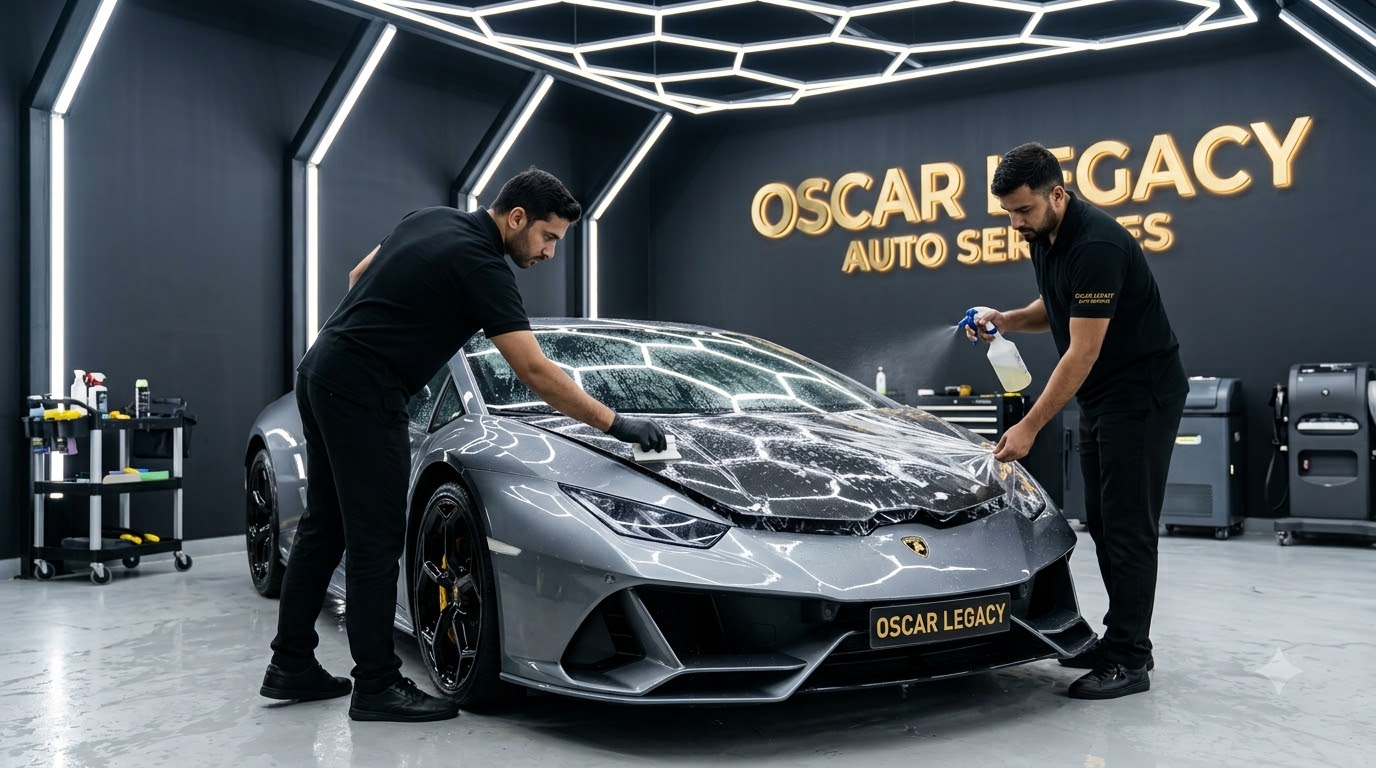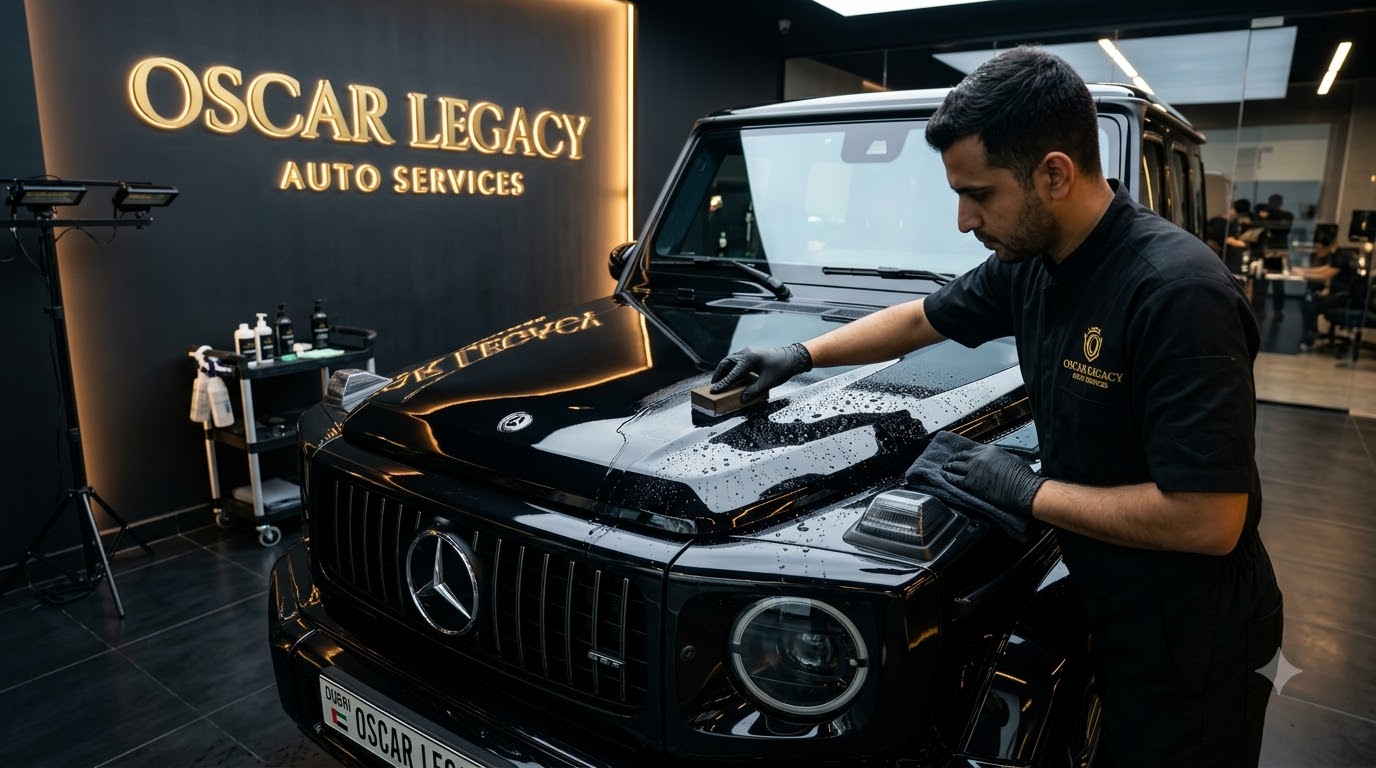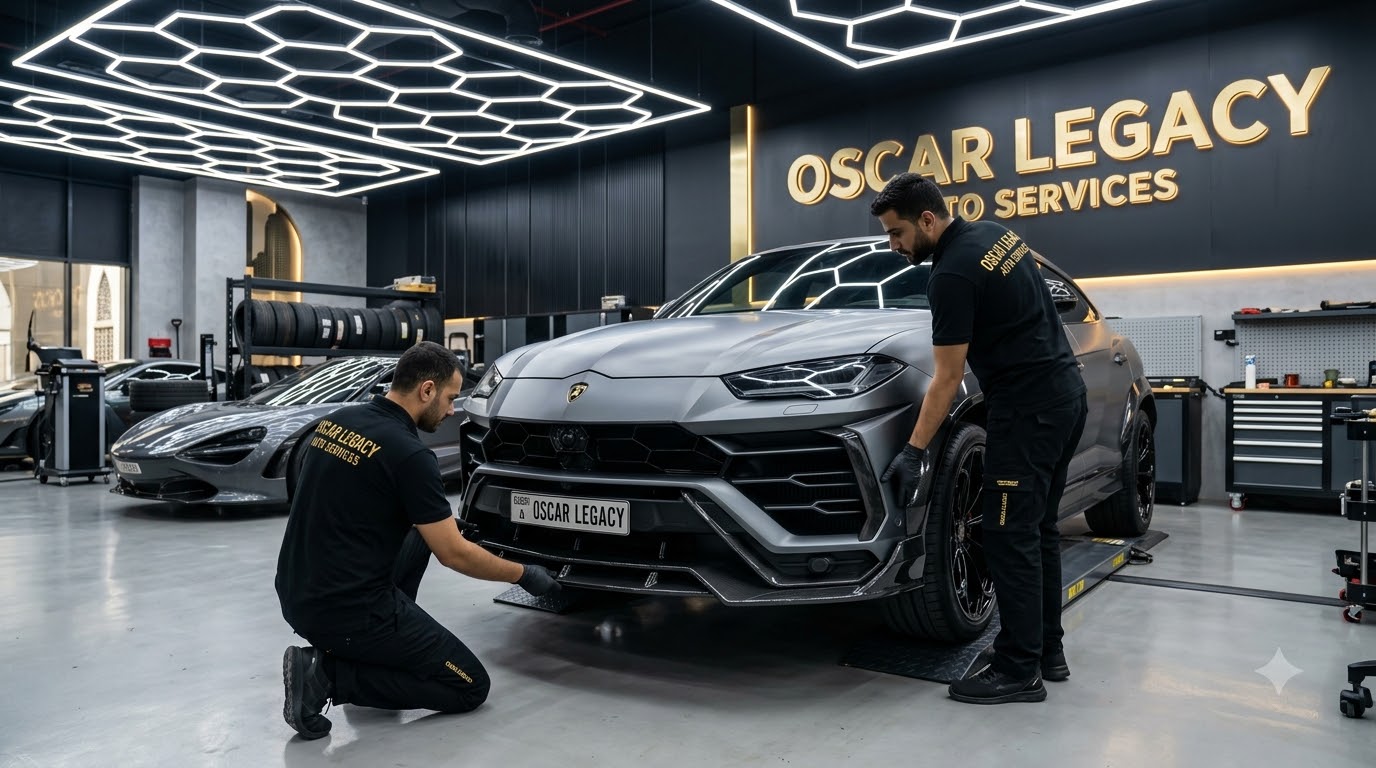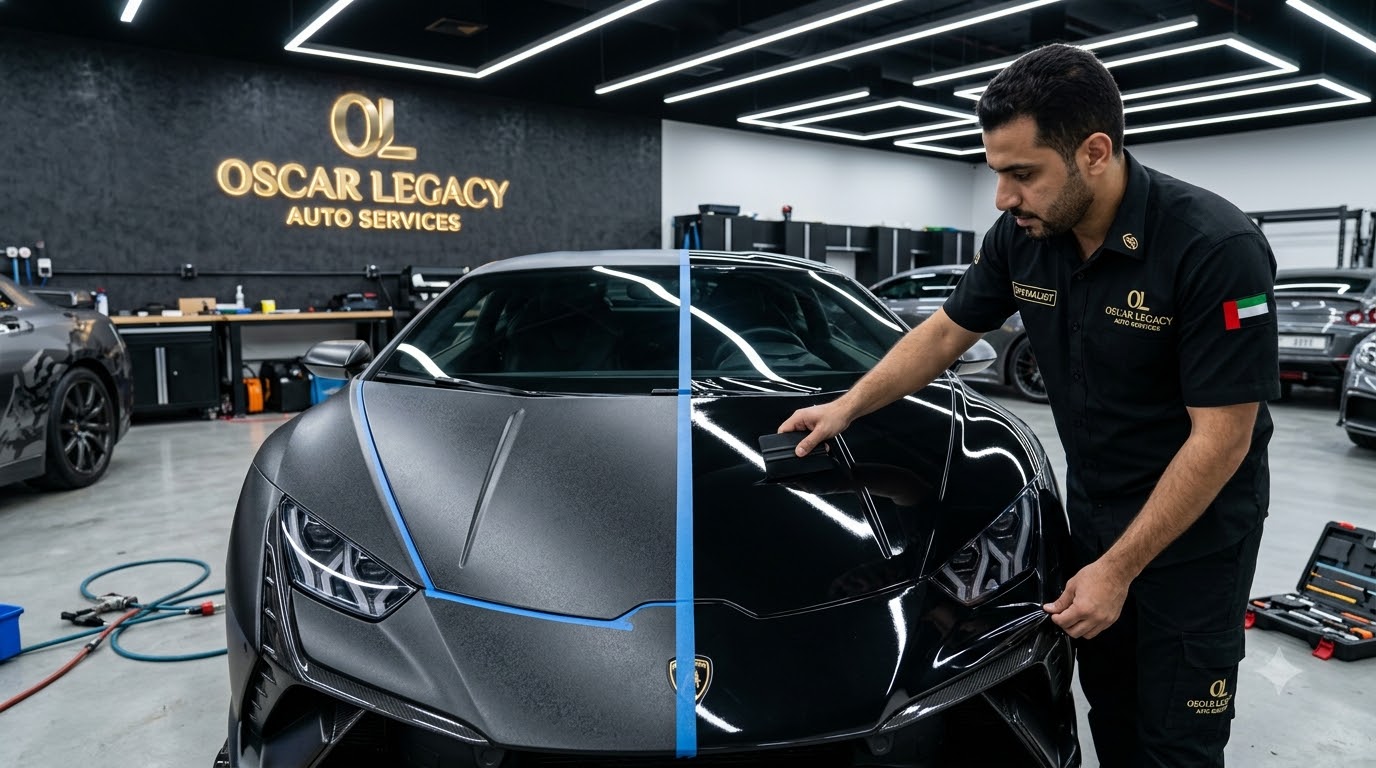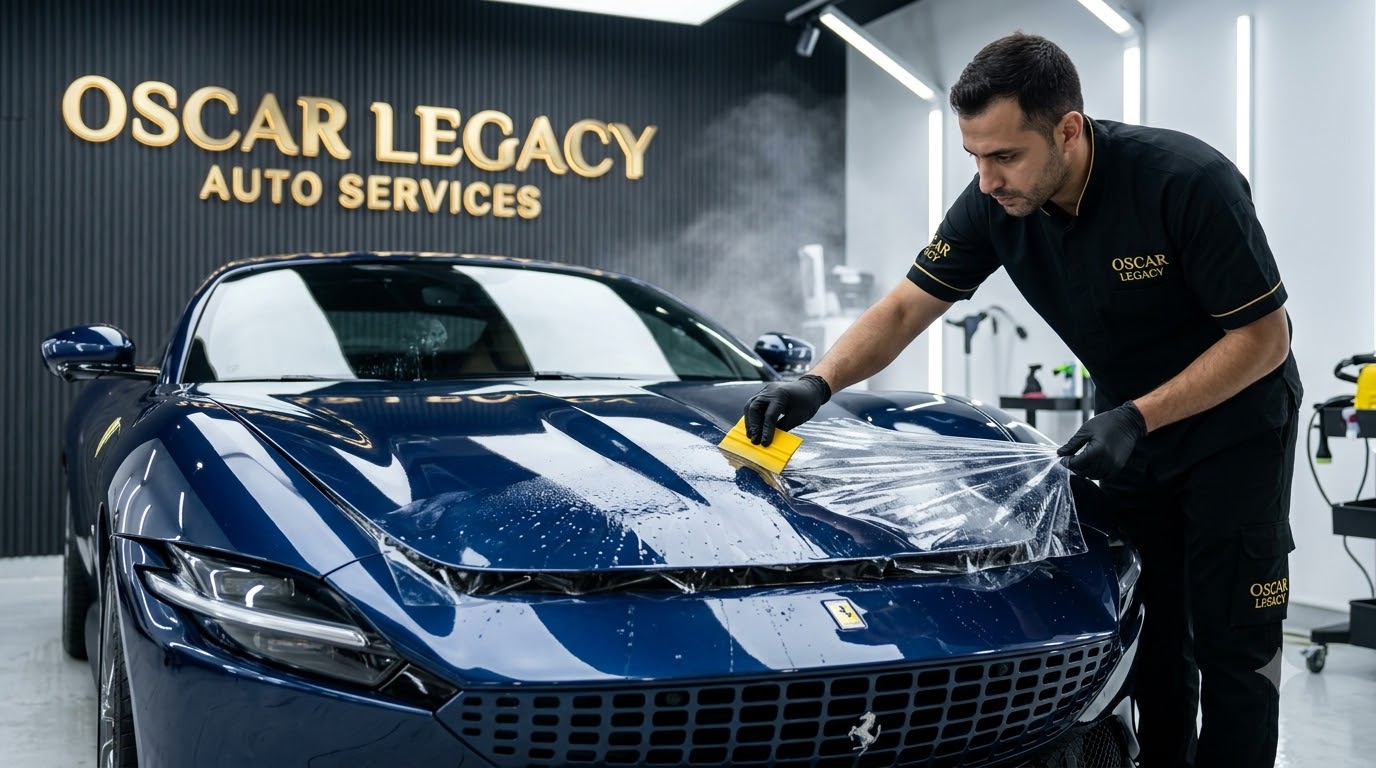
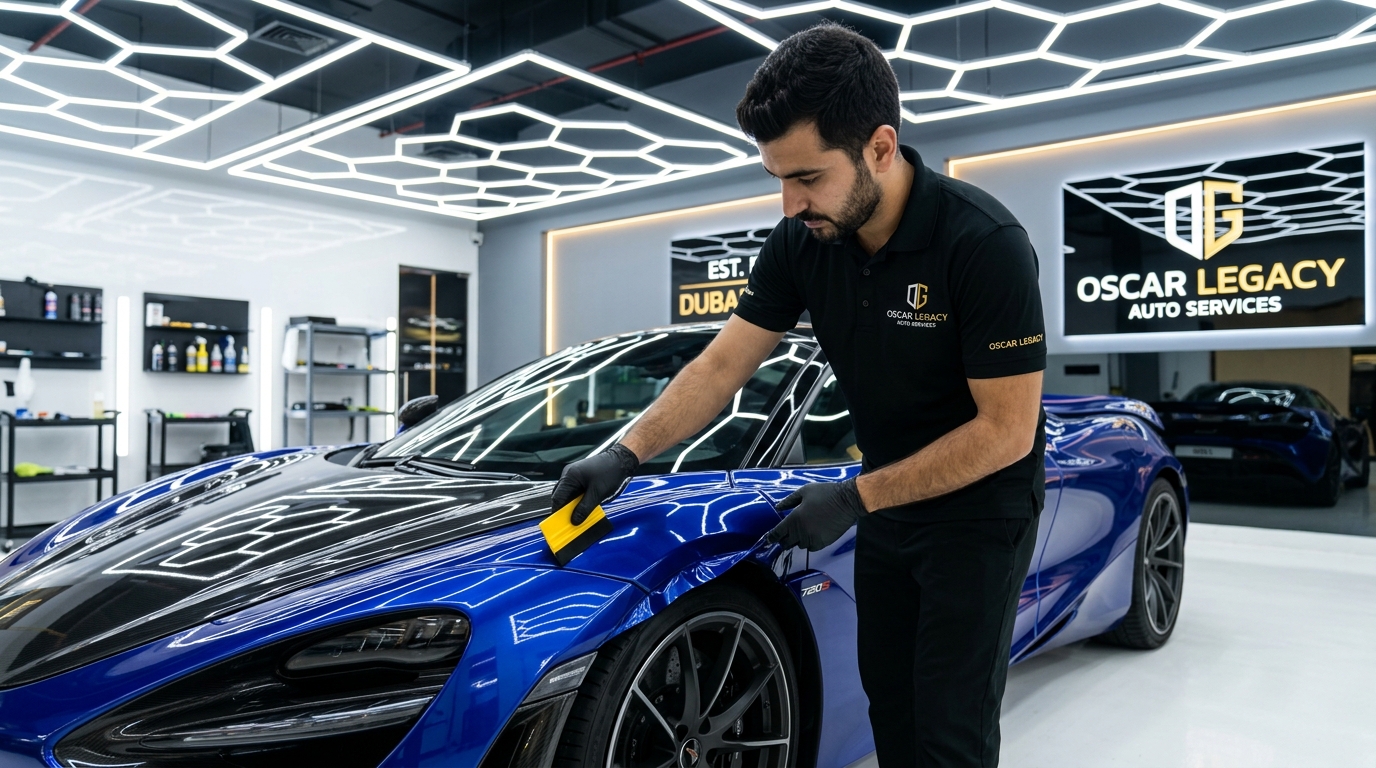
If you own a Ferrari, a Lamborghini, a McLaren, or a Porsche 911 GT3, changing the color isn't just about turning heads on Sheikh Zayed Road. It's about doing it in a way that doesn't compromise the paintwork underneath — paintwork that cost a small fortune to begin with.
Two options tend to dominate this conversation in Dubai right now: colored paint protection film (PPF) and traditional cast vinyl wraps. Both can completely transform how your car looks without touching the factory paint. But they're not interchangeable — the protection, the lifespan, and the long-term value differ quite a bit between the two. So the real question becomes: does colored PPF's higher price tag actually hold up? For most owners who care about both the look and protecting what's underneath, premium 8-mil TPU colored PPF tends to come out ahead. At Oscar Legacy Auto Services, we analyze the engineering, durability, and financial realities of both solutions.
1. What Actually Separates Colored TPU PPF From Vinyl Wrap
Colored PPF is a multilayer film, usually built on thermoplastic polyurethane (TPU), that does two jobs at once — gives your car a new color and sits as a genuine protective layer over the original paint. The premium versions run around 8 mil thick (roughly 203 microns), often with self-healing topcoats and a choice of high-gloss or satin finishes.
Vinyl wraps work differently. They're thinner PVC-based films — premium cast vinyl usually sits around 3 to 4 mil — and they exist mainly to change how the car looks, not to add meaningful protection against impact.
2. Side-by-Side Comparison: Colored TPU PPF vs Premium Cast Vinyl
Here is how the two technologies stack up across every crucial specification:
| Feature | Colored TPU PPF | Premium Cast Vinyl |
|---|---|---|
| Thickness | ~8 mil (203µ) Robust barrier | ~3–4 mil (75–100µ) Thin film |
| Rock-chip defense | ✓ Strong protective barrier | Limited impact resistance |
| Self-healing | Yes (on compatible premium films) | Generally no |
| Color options | Expanding premium range (OEM match) | Wider selection & custom textures |
| Finish | Factory-like gloss, satin or matte | Gloss, satin, matte, textured |
| Warranty | Select films offer 7–10 years | Varies, often shorter on horizontal panels |
| Initial cost | Higher upfront investment | Lower initial entry point |
| Ideal owner | Long-term paint preservation & exotics | Budget-conscious or frequent color changers |
Oscar Legacy Studio Diagnostic: Film Engineering Standards
Verified Technical Benchmarks for Exotic Vehicle Color Conversion in Dubai
3. Rock-Chip Protection — Why 8-Mil TPU Actually Matters
Driving a performance car in Dubai means dealing with highway debris, airborne sand, and the kind of low ground clearance that practically invites stone chips. A GT3's front splitter, a McLaren's side intakes, a Lamborghini's aggressive lower bodywork — all of it sits right in the firing line.
Premium colored PPF works as a physical cushion here. It absorbs minor impacts and cuts down the chances of stone chips actually reaching the paint underneath. That's really the appeal — one installation, two jobs: a dramatic new look and genuine protection.
Vinyl, by comparison, offers more of a cosmetic shield. It'll handle light contact and general weathering fine, but its thinner build simply isn't built for the same kind of impact resistance. For a car with factory paint that costs what exotic car paint costs, that gap matters.
4. Self-Healing Films and That Factory-Fresh Look
This is where premium TPU PPF really separates itself — the self-healing topcoat. Light swirl marks and fine scratches can fade away on their own when the film warms up, within whatever limits the manufacturer specifies. If you're the type who wants the car looking sharp between detailing sessions, this feature alone can be worth the upgrade.
Good colored PPF also delivers a gloss finish that's genuinely close to factory paint, with minimal surface texture. That said, don't assume a perfectly smooth, zero-orange-peel finish without actually looking at a sample or a completed job first — both the film quality and the installer's skill play into the final result.
High-gloss cast vinyl has gotten impressively good too, reflection-wise. But it still doesn't match PPF on self-healing or impact protection — that's just not what it's designed for.
5. What Colored PPF Actually Costs in Dubai
Pricing swings depending on the car's size, the film brand, the finish you want, how complex the body panels are, and how skilled the installer is. As a rough guide for the Dubai market in 2026:
| Customization Type | Approximate Full-Body Cost |
|---|---|
| Premium cast vinyl wrap | AED 4,500–14,000+ |
| Premium colored PPF (exotic cars) | AED 15,000–30,000+ |
These numbers are ballpark figures, not fixed quotes — a genuinely complex exotic car installation can easily run higher. Cars like the Ferrari or McLaren, with their sharp lines, deep curves, and tight aero components, demand a lot more precision and time from the installer.
Yes, PPF costs more upfront. But it can also mean fewer cosmetic paint repairs down the line and a finish that holds up longer. If you're planning to keep the car for a few years, it's worth thinking in terms of total value rather than just the installation invoice. That said, if you like switching up colors often or just want the cheapest route in, vinyl still makes a lot of sense.
6. The Warranty Gap — 7 to 10 Years vs. Something Shorter
Premium colored PPF products can come with warranties stretching close to a decade. XPEL, for instance, backs its COLOR PPF with a 10-year limited manufacturer warranty covering specified film defects, including yellowing, cracking, blistering, and delamination.
Vinyl warranties tend to look quite different. The UAE product information for 3M Wrap Film Series 2080 describes warranty periods of up to six years on vertical surfaces and one year on horizontal surfaces in its FAQ.
Worth remembering — a warranty isn't a guarantee the film stays flawless the whole time. Before you commit to anything, ask specifically whether the warranty applies to UAE installations, what's actually covered, how horizontal panels are treated differently, and whether labor is included if something goes wrong. Dubai's heat and sun exposure make the installation quality and upkeep just as important as the product itself.
7. Colors Worth Considering for Ferrari, Lamborghini and Porsche
The right color really depends on the car's shape and character. Three that consistently work well for exotic car customization:
- Fashion Grey: Clean, modern, and exceptional at highlighting sharp lines and aerodynamic surfaces. Looks particularly sharp on a Porsche 911 GT3 or McLaren 720S/750S.
- British Racing Green: A deep, heritage-feeling green that gives the vehicle a refined, distinctive presence. Works beautifully on sculpted grand tourers and mid-engine supercars.
- Chalk: A soft, muted grey that leans into understated luxury while making widebody arches, aggressive front bumpers, and gloss-carbon details stand out dramatically.
How a color actually reads depends heavily on the film manufacturer, so it's worth looking at real swatches in both daylight and showroom lighting before committing to a full wrap.
8. So — Is Colored PPF the Better Choice for Exotic Cars in Dubai?
If preserving the factory paint matters to you as much as the new look does, premium colored TPU PPF is generally the stronger investment for a Ferrari, Lambo, McLaren, or GT3. You get a highly customizable finish, real protection against everyday road hazards, and a product that tends to last longer.
Vinyl still has its place — it's great for shorter-term transformations, experimental finishes, or if you just want more color variety without spending as much upfront. At the end of the day, it comes down to one question: is the look alone enough, or does protecting the original paint matter just as much to you?
View Live Colored PPF Swatches via WhatsApp
Before you commit to your next color transformation, see the actual film first. Browse Fashion Grey, British Racing Green, and Chalk, request live swatch videos, compare finishes under studio lighting, and receive a tailored quote built around your vehicle.
9. Frequently Asked Questions
Is colored PPF better than vinyl wrap in Dubai?
For long-term protection and color customization, yes, it generally performs better. Vinyl tends to be more budget-friendly and offers more decorative variety.
Does colored PPF stop all rock chips?
Not entirely. Quality TPU PPF significantly improves resistance to stone chips, but a hard enough impact can still get through to the paint.
Can self-healing PPF fix deep scratches?
No — it's built for light surface marks and swirls, not punctures or deep gouges reaching the paint.
Can colored PPF be removed safely?
Generally yes, if it's quality film being removed from sound, original paint by someone who knows what they're doing. The paint's condition and removal technique both matter here.
Do I need approval to change my car's color in Dubai?
Yes. Dubai's vehicle colour-change process includes the applicable Dubai Police approval and updating the vehicle details through the Roads and Transport Authority. Always confirm current requirements before going ahead with installation.
Pick the color you want. Give your exotic car the protection it deserves too. Consult with Oscar Legacy Auto Services to explore premium colored PPF collections engineered for Dubai's climate.