Most Mercedes-AMG owners know this routine: you get the car properly cleaned on Friday, and by Sunday evening the front wheels have a dull grey layer on them. The paint still looks perfect, but the rims look like they've been ignored for a month. BMW M and Audi RS drivers have the same complaint. So does anyone with big Brembos behind the spokes of a Ferrari, Lamborghini, or Porsche.
The cause is simple: performance brakes shed a lot of dust. In Dubai, with hot roads, sand in the air, and humid mornings, that dust doesn't just sit there quietly. Leave it long enough and a quick wheel wash turns into an expensive refinishing job. A wheel ceramic coating won't stop your brakes from making dust — and anyone who says otherwise is overselling it. What it does is give the dust a much harder surface to hold onto. At Oscar Legacy Auto Services, we explain what's really happening to your wheels and how heat-resistant coatings protect your alloys.
1. Why Fast Cars Have Dirty Wheels
There's a good reason the front wheels of a C63, M3, or RS6 get dirty long before the rest of the car does. These are heavy, powerful cars built to slow down hard, again and again. To do that consistently, their brakes use friction materials chosen for performance first and cleanliness a distant second. Every press of the pedal squeezes the pads against the spinning discs. That friction turns speed into heat, and tiny particles wear off both the pads and the discs in the process.
What is that grey powder, exactly? Brake dust isn't ordinary road dirt. Depending on the setup, it usually contains iron and iron oxides from cast-iron discs and pads, metallic and mineral ingredients from the pad compound, carbon-rich particles, and fine abrasive grit worn from braking surfaces. Many European performance cars use low-metallic pads that leave heavy residue. Carbon-ceramic brakes wear differently from conventional iron discs, so two AMG or M cars can produce very different dust amounts. The key point is that the residue on performance wheels sticks far more stubbornly than sand or ordinary road grime.
2. The "400°C Brake Dust" Claim
You may have heard that performance brakes throw off dust at 400°C that burns straight into your wheel paint. The worry is understandable, but that version of the story isn't quite accurate. Under heavy braking, discs and pad surfaces can reach several hundred degrees — around 400°C is realistic in hard use, and extreme track conditions climb well beyond that. That doesn't mean the dust on your wheel is sitting there at 400°C; particles cool quickly once they leave the brake.
So why is it so hard to get off? Fine metal particles settle into the microscopic texture of the wheel's clear coat. As more builds up, some oxidises, stains the surface, or bonds firmly over time. Moisture and Dubai's climate speed this up. On gloss black wheels, it shows up as a loss of shine or dark marks that won't wash off. Leave it long enough and the finish can pit — especially painful on forged or diamond-cut alloys that cost a small fortune to refinish.
3. How a Wheel Ceramic Coating Works
A wheel coating is a specialized protective layer engineered to bond to wheel finishes. Based on silicon chemistry, it cures into a hard, cross-linked film over the existing clear coat. The result is a surface that dirt struggles to grip, water runs off easily, and cleaning takes far less effort.
- Less sticking: Brake dust and road grime don't bond tightly to a coated surface, washing off with minimal effort.
- Water beading: Water rolls off taking loose dirt with it, reducing scrubbing and eliminating wash marring.
- Chemical and heat resistance: Formulated specifically for wheels to handle repeated heating, cooling, and road fallout.
To be clear, a coating doesn't make wheels indestructible. It is a sacrificial barrier between the original finish and the road. You'll appreciate it most on complex multi-spoke designs where cleaning between spokes normally takes ages.
Oscar Legacy Studio Diagnostic: Wheel Thermal Standards
Verified Technical Benchmarks for Performance Alloys in Dubai
4. High-Temp Wheel Protection in Dubai: Is 9H Heatproof?
This is where marketing language causes confusion. Ads talk about "9H ceramic wheel armour" and "high-temperature protection" as if they mean the same thing. They don't. 9H comes from a pencil hardness test — it tells you how well a film resists surface scratching under pencil testing, but says nothing about heat tolerance.
What actually matters is thermal stability. Established specialist products publish heat ratings: Gtechniq C5 Wheel Armour is rated up to 600°C, and GYEON Q² Rim EVO advertises resistance above 800°C. These figures represent what the coating tolerates without degrading. A microns-thin coating won't insulate or cool your brakes; its job is to stay stable and protect the finish in a punishing environment.
5. Ceramic Coating Calipers and Rims Together
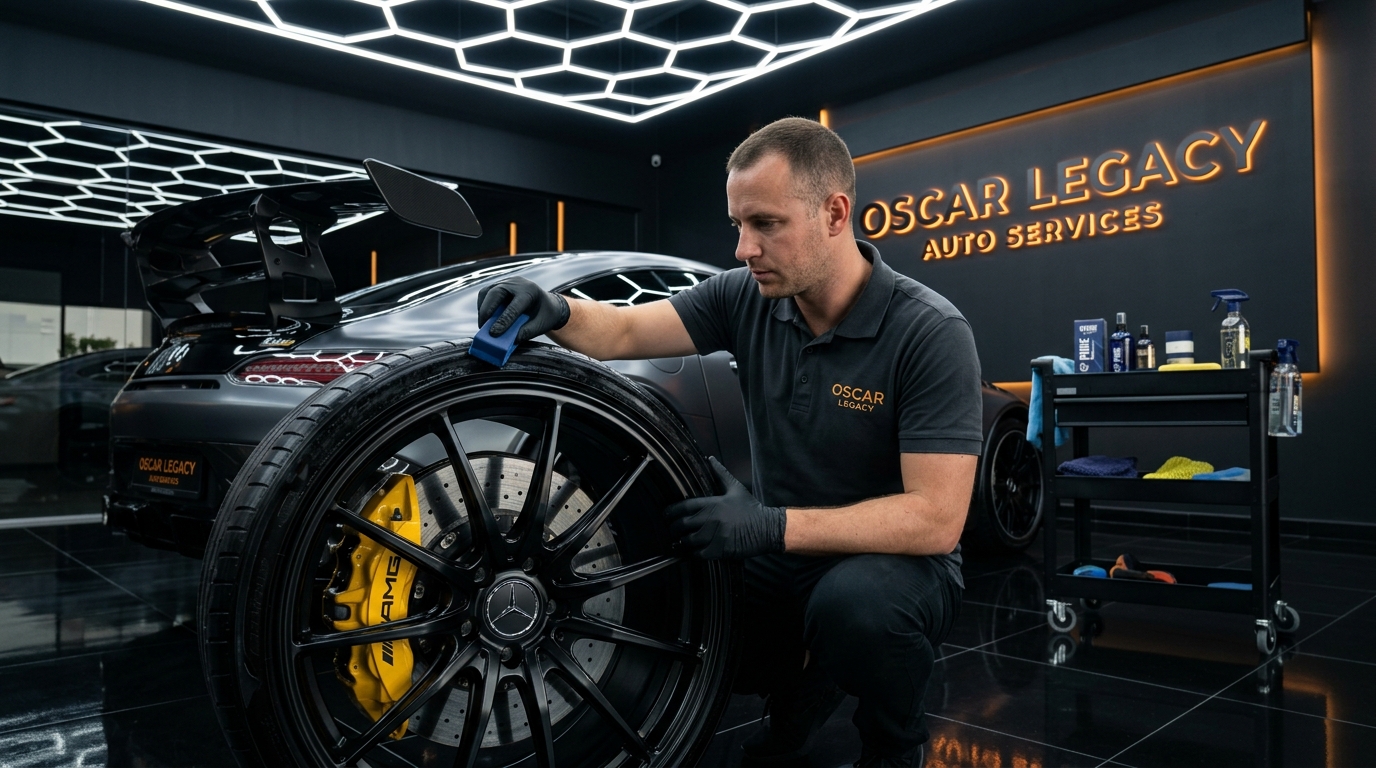
Look through the spokes of an AMG GT or a Porsche 911 and the calipers stand out almost as much as the wheels. Red, yellow, blue, or acid green, they are key to the vehicle's aesthetic. They also sit directly adjacent to heat and dust. Applying a high-temperature coating to clear-coated caliper exteriors keeps them easier to clean and prevents dust from dulling their vibrant color.
What can and can't be coated: Painted wheel faces, inner barrels, and compatible clear-coated calipers are suitable. However, coating should never touch friction surfaces of brake discs, brake pads, or braking contact parts. Wheel mounting hubs and fastener seats must also remain free of residue. At Oscar Legacy, we follow strict manufacturer torque and fitment specifications.
6. Can You Really Clean Coated Wheels With Just Water?
On a well-maintained coated wheel, light dust often rinses away with plain water. But if someone claims you will never need shampoo again, be skeptical. Oily traffic film and fine particles still build up.
A sensible cleaning routine: Let wheels cool completely and wash in the shade. Start with a gentle rinse to remove sand. Use a pH-neutral car shampoo with a soft microfiber wheel brush, rinse thoroughly, and dry with a clean towel or filtered air. Occasionally, use a pH-neutral iron fallout remover for embedded deposits. Strong acidic cleaners are unnecessary and risk damaging delicate forged finishes.
7. Wheel Faces Only, or the Full Wheel?
When comparing wheel coating packages in Dubai, ask exactly which surfaces are covered:
| Treatment Level | Surfaces Covered | Best Suited To |
|---|---|---|
| Wheel faces | Visible spokes and outer face | Everyday luxury sedans and daily drivers |
| Full wheel | Faces plus reachable inner barrels | Multi-spoke and forged performance wheels |
| Wheels and calipers | Full wheels plus compatible calipers | AMG, M, RS, and supercar owners |
Taking wheels off allows thorough cleaning and complete coverage of inner barrels and calipers, provided qualified technicians remove and re-torque them properly.
8. Preparation Decides the Result
Before any coating is applied, every trace of old grime, baked-on brake dust, and metal fallout must be removed using finish-safe decontamination chemicals. Any paint defects are assessed, the surface is degreased with isopropyl alcohol, and the coating is cured in a climate-controlled bay before exposure to moisture. Applying a coating over dirty wheels locks in contamination and causes premature failure.
9. Is It Worth It for Your Car?
- Mercedes-AMG owners: High-dust pads make dedicated wheel coatings a game-changer for weekly upkeep.
- BMW M owners: Complex multi-spoke alloys benefit immensely from barrel and spoke protection.
- Audi RS owners: Large rims and powerful brakes mean controlling dust keeps the car looking sharp between details.
- Ferrari, Lamborghini & Porsche owners: Protects expensive forged alloys and bright calipers from harsh chemicals and staining.
10. The Bottom Line
Performance brakes are designed to stop fast cars, not to keep wheels clean. The heat and metal dust are part of the deal. What you can control is how much of that dust sticks and how hard you have to work to remove it. The right coating makes rims and calipers much easier to look after through hard braking and Dubai's climate.
Protect Your Wheels at Oscar Legacy Auto Services
On a performance car, the details matter. Our ceramic packages include options for wheel faces, complete off-car barrel treatment, and caliper protection. Inquire today for a tailored quote.
10. Frequently Asked Questions
Does a wheel ceramic coating stop brake dust?
No. Brake dust comes from the pads and discs rubbing together, and a coating doesn't change that. What it does is stop the dust from bonding as firmly to the wheel, so it's easier to wash off.
Is a 9H ceramic coating heatproof?
No. 9H is a hardness rating, not a heat rating. Heat resistance has to be shown by separate testing and the manufacturer's specifications.
Can Brembo calipers be ceramic coated?
In many cases, yes. Compatible coatings can go on the outside of some painted or clear-coated calipers, following product guidance. They must never touch discs, pads, friction surfaces, or sensitive brake parts.
Can coated wheels be cleaned without acid cleaners?
Yes. Routine washing usually needs nothing more than water and a pH-neutral shampoo, and light dust may come off with water alone. An iron remover may still be needed occasionally.
Will a wheel coating protect against Dubai sand?
It makes loose dust easier to rinse away, but it can't stop sand from scratching the surface if it's rubbed in. Always rinse off grit before touching the wheel.
How long does a wheel coating last in Dubai?
That depends on the product, how you drive, and how the wheels are maintained. Check the wheel-specific product details rather than assuming it will last as long as a bodywork coating.
On a performance car, the details matter. At Oscar Legacy Auto Services, we deliver precision, protection, and automotive excellence for Dubai's finest wheels.